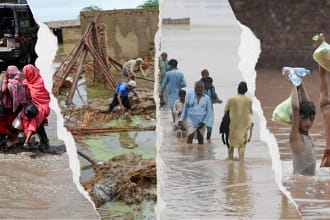



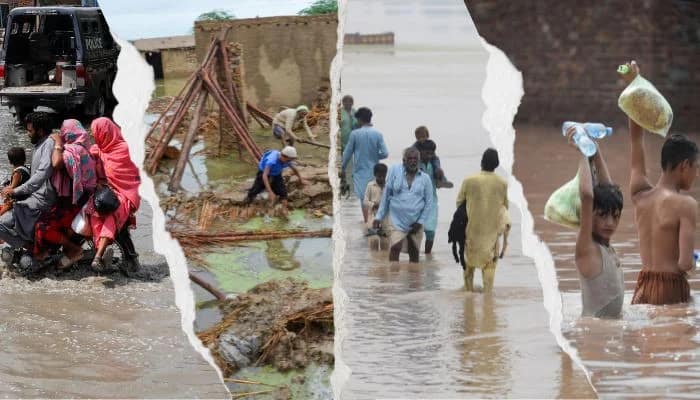
When the floodwaters reached Ali Sher Koso’s village in Jacobabad on August 22, 2022, there was no place left to run for him. “We lost everything, our crops, our animals, our home. However, what hurts the most is leaving behind our parents’ graves. You can always earn money again, but you can never replace the place you and your family belonged to.”
For the 42-year-old farmer, the flood wiped out years of hard work within hours. Six to seven feet of muddy water covered his fields, destroying the family’s crops and drowning their livestock.
Their tractor, farming tools and stored grain were also lost. With the roads submerged and nowhere else to go, Koso, his wife, and their eight children spent the night on a charpoy placed on top of a flood embankment, alongside hundreds of other families waiting for the water to go down.

“We thought that we would return in a few days,” he recalled. “Instead, we had to leave everything behind.”
Almost three years on, Koso’s family is living in Kotri, Jamshoro, hundreds of kilometres away from the land that had supported generations of his family. While he now earns a higher daily wage than he did before, almost every rupee disappears into rent, transport, healthcare and household expenses.
“The hardest part wasn’t losing money,” he said. “It was leaving behind our ancestors’ graves.”

The family estimates that the flood destroyed nearly Rs4 million worth of crops, livestock and agricultural assets. Migrating and starting over cost them a further Rs400,000.
Crisis beyond floods
Pakistan is responsible for less than 1% of the world’s greenhouse gas emissions, but it is among the countries bearing one of the heaviest consequences of a changing climate. Floods, droughts, scorching heat and rising seas are forcing families to migrate.
The catastrophic floods of 2022 illustrated the scale of that vulnerability. Triggered by record monsoon rains and accelerated glacial melt, the disaster submerged nearly one-third of the country, affecting more than 33 million people and displacing millions from their homes.
In some areas, entire villages were left underwater, while damaged roads, schools, hospitals and irrigation networks made it difficult for people to resume their normal lives even after the floodwaters receded.

For some families, displacement follows a sudden disaster; for others, it happens gradually as their livelihood becomes harder to sustain. Researchers say migration is increasingly driven by both sudden disasters and slower environmental changes.
In upper Sindh, hotter temperatures, desertification and unpredictable rainfall are putting greater pressure on farmers whose livelihoods depend on agriculture. At the same time, sea intrusion and salinity are threatening farmland and fishing communities on the Arabian Sea.
“Migration may often be used as an adaptation strategy,” explained climate researcher Ayesha Qaisrani. “But for many families, it becomes the last available option when maintaining livelihoods is no longer possible.”
“The biggest financial burden isn’t simply moving,” she noted. “Families lose farmland, livestock, assets and income. Many borrow heavily just to escape disaster. When displacement continues for months or years, children’s education suffers, healthcare becomes unaffordable, and families remain trapped in debt.”
Hidden cost of living
Hundreds of kilometres south of Jacobabad, lived twenty-four-year-old Muhammad Jutt, who grew up fishing along Sindh’s coast, where the sea had long been his family’s source of income. For years, the catch was enough to feed his wife and their two young daughters.
However, in 2022, flooding near the coast destroyed his entire house, while repeated environmental shocks made it harder for the family to survive. Eventually, they moved to Keti Bandar, hoping to find a more secure life.
“My children were hungry, and we had nowhere left to live,” Jutt recalled from the day of the disaster.
He sometimes makes between Rs2,000 and Rs2,500 a day, but there is no guarantee of regular work. Clean drinking water is difficult to find, healthcare facilities are almost nonexistent, and his daughters are still out of school.
Jutt estimates that moving cost his extended family between Rs2.5 million and Rs3 million.

“We need work, hospitals, electricity, education and water, not your sympathy,” stated Jutt.
For coastal families like Jutt’s, displacement often happens quietly. Instead of one catastrophic event forcing migration, survival becomes harder each year until staying becomes harder than leaving.
An International Water Management Institute (IWMI) survey involving 826 climate-displaced households in Rahim Yar Khan found that average monthly household income after migration stood at just Rs16,545, while average expenditure exceeded Rs23,900, forcing many households into debt.
Most respondents depended on casual daily wage labour after losing farmland, livestock or other traditional sources of income. The study also found widespread food insecurity and deeper poverty among displaced households after migration.
When relief isn’t enough
For humanitarian organisations working with disaster-hit communities, climate migration does not start when a family reaches a relief camp. It starts much earlier, when people begin losing the means of support themselves.
Dr Shaikh Tanveer Ahmed, Chairman of HANDS Welfare and HANDS Institute of Development Studies, said: “People don’t willingly abandon their villages. They leave because surviving becomes impossible.”
People don’t willingly abandon their villages. They leave because surviving becomes impossible.
— Dr Shaikh Tanveer Ahmed, Chairman of HANDS Welfare and HANDS Institute of Development Studies
Thousands of families spent weeks on roadsides, embankments and makeshift shelters before they could reach relief camps. Access to clean water, sanitation, healthcare and education remained limited. Meanwhile, women and children faced greater risks of disease, malnutrition and hygiene and protection-related problems.
Ahmed said Pakistan needs to prepare for displacement before disasters strike.
“What we need is not just better disaster response but better disaster preparedness,” he said. “Investment in climate-resilient agriculture, stronger embankments, functioning rural health facilities and early warning systems is essential if Pakistan hopes to reduce future displacement.”
The Pakistan Red Crescent Society (PRCS), which has responded to floods, heatwaves and other disasters, has also seen how long the financial consequences can last.
They stated that Pakistan needs to move beyond treating climate displacement as a short-term emergency by incorporating climate migration into national planning and strengthening social protection systems.
The warning that never came
The IWMI also found that fewer than half of those surveyed had received an official warning before an extreme weather event. For many of those who did not receive information, it didn’t come from government alerts, but through neighbours or relatives.
Access to information was even more limited for women. Nearly three-quarters of surveyed women lacked personal mobile phones, making it harder for them to receive emergency alerts, weather updates and disaster-related information. Television, radio and digital communication were also not reaching many vulnerable households, leaving communities to rely on informal networks during emergencies.
Kanwal Waqar, Regional Researcher and Gender and Social Inclusion Specialist at IWMI, stated that climate migration can no longer be treated as something that happens once and is resolved through emergency assistance.

“Our research shows that climate-induced migration is becoming a recurring reality for many communities,” she said. “Strengthening digital ecosystems and early warning systems is critical, but they must also be inclusive. Women, older persons and marginalised groups cannot be left behind simply because they lack access to technology.”
Counting the true cost
The number of people displaced by a flood or other disaster is relatively easy to record compared to capturing what happens to them afterwards.
There are obvious losses: homes, crops, livestock and business. But there are also costs that rarely make it into official damage records. Families have to pay for transport, rent and medical treatment. Identity documents may need to be replaced.
Children lose months or even years of schooling. Parents lose wages while looking for work, and many borrow money simply to keep their households running.
For families like Ali Sher Koso’s, recovery has stretched across years. The farmland that once sustained his family is no longer productive. The livestock they built over decades is gone. Even though he now earns more in Jamshoro than he did before the floods, higher living costs consume much of that income.
Meanwhile, for Muhammad Jutt, the loss is harder to put into numbers. Fishing once gave his family a way to survive; now, even a day’s work is uncertain.

Their experiences show that climate migration is more than moving from one place to another. A family can find a new roof and still lose the security, livelihood and a sense of belonging that made their old home a place to live.
The World Bank estimates that, without stronger climate action and resilient development, more than 216 million people could become internal climate migrants by 2050. In Pakistan, IWMI researchers estimate that around 2 million people could be pushed into climate migrants by mid-century as floods, droughts and other climate extremes intensify.
For many experts, the emergency relief can only address part of the problem. Preventing repeated displacement will require investments in stronger infrastructure, sustainable livelihoods and reliable early warning systems, as well as development policies that account for the communities most exposed to climate risks.
Back in Kotri, Koso has stopped thinking about returning to Jacobabad. His priority now is more immediate: giving his children the stability he lost.
“We survived,” he said, looking around the rented house his family now calls home. “But surviving isn’t the same as living.”
For families like Koso’s and Jutt’s, the damage does not end when the floodwaters recede, or the fishing grounds become unproductive. It continues through lost income, interrupted education, debt and years spent trying to build a life somewhere new. That is the actual price a climate migrant has to pay just for one thing: survival.
The author is a staffer at Geo.tv
2026-08-03 17:06:00