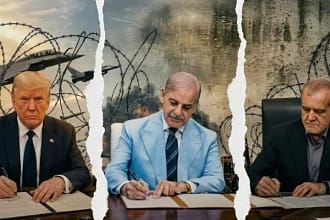



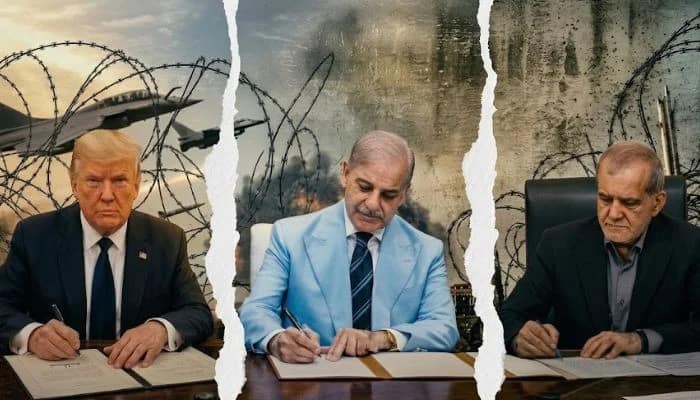
More than 100 days after the United States and Israeli bombs began falling on Iran, Washington and Tehran have “electronically” signed an initial agreement to end their war following efforts primarily by Pakistan and Qatar.
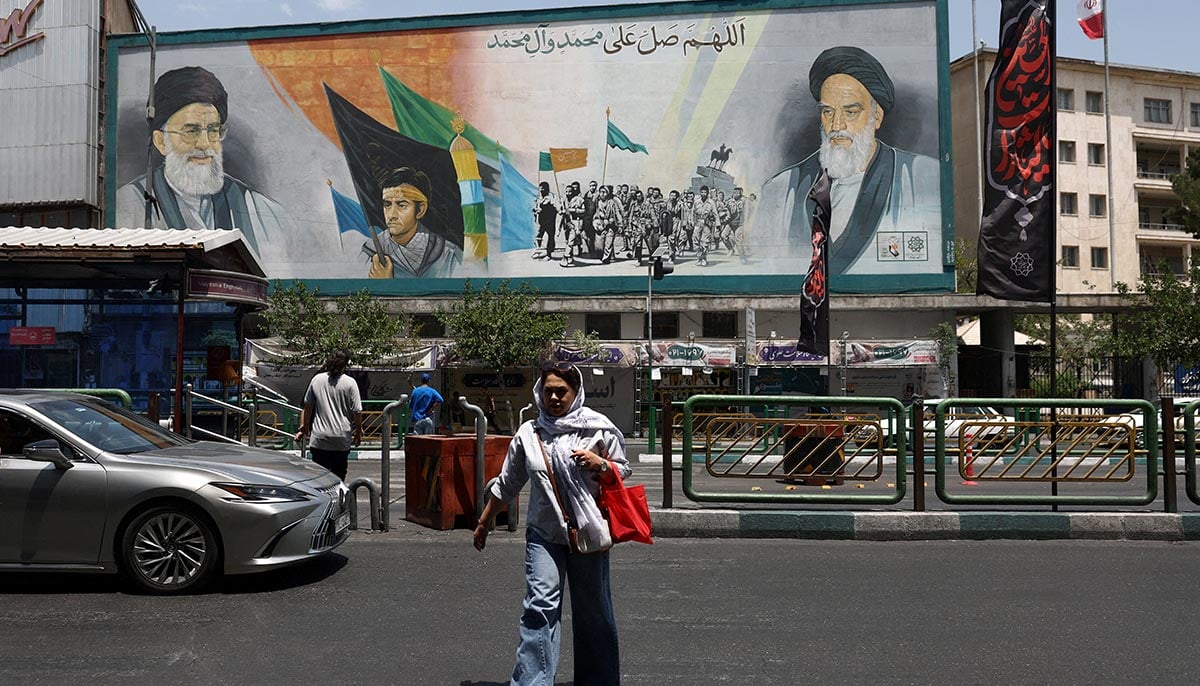
The US and Israel launched the war on Iran, martyring the 86-year-old Supreme Leader Ayatollah Ali Khamenei and military leaders on the first day. It quickly spiralled into a regional conflict that has killed more than 7,000 people, mostly in Iran and Lebanon; driven up energy prices; renewed inflationary pressures and sparked concerns about a major food supply crisis in developing countries.
The 14-point memorandum of understanding, signed separately by US President Donald Trump and Iranian President Masoud Pezeshkian and Prime Minister Shehbaz Sharif as a mediator, sets out a 60-day framework for negotiations over Iran’s nuclear programme but it also confirms an immediate halt to military operations on all fronts, including Lebanon, the reopening of the Strait of Hormuz, lifting of the US naval blockade on Iranian shipping, and a $300 billion investment fund for the Islamic Republic’s post-war reconstruction.
Iran also undertakes not to build nuclear weapons, reaffirming a vow it had made for decades. It also agreed to the on-site “down-blending” of its stockpile of enriched uranium under the supervision of the International Atomic Energy Agency, although Trump had wanted to take it out of the country, which Iran has rejected.
Trump chose to formalise it at the Palace of Versailles, the site of the signing of the eponymous treaty that formally ended World War I.
While the initial agreement appears to have ended the fighting and opened the door to diplomacy, the most contentious issues — including Iran’s nuclear programme, uranium enrichment activities and sanctions relief — are to be negotiated over the next 60 days. The current agreement serves as a framework for broader talks rather than a comprehensive settlement.
Geo.tv spoke to Middle East experts and strategic analysts to examine what the initial agreement between Washington and Tehran offers and how it would shape the broader talks, meant to decide the future of the region.
Israel can be a spoiler
Shortly after Trump announced signing the much-awaited deal, Israeli far-right ministers and some lawmakers in the US lambasted the deal that, according to them, failed to curb Iran’s missile programme and provided no clear path to dismantling its nuclear facilities, while constraining Israel in its war with Hezbollah in Lebanon.
Trump has repeatedly criticised longtime ally Israel, spiking tensions nearly four months after the two countries partnered to attack Iran.
Also, Israel, which continues violating the ceasefire in Gaza and Lebanon, even at the time of writing this article, is not a signatory to the memorandum.
Mohammad-Makram Balawi, Director General of the League of Parliamentarians for Al-Quds (LP4Q), believes that under this MoU, to which Israel is not a signatory, the only remaining enforcement mechanism is “American pressure and leverage,” which is typically fragile and does not prevent Israel from executing strikes it claims are vital to its security.
He believes, however, that Trump has a personal incentive to hold Israel back — at least temporarily. “The US president is interested in buying a 60-day cooling-off period because he has his eyes set on the US midterm elections. The continued fallout of the war harms the global economy and his party’s prospects.”
Egyptian journalist Ibrahim Mostafa agrees that Washington’s self-interest may serve as a restraint. “I believe that the pressure from the Trump administration will prevent Israel from continuing its strikes in southern Lebanon,” he says, pointing to Vice President JD Vance’s warning that Israel should not lose its only ally. “However, this does not mean that Netanyahu will stop his attempts at escalation, given the approach of the Israeli legislative elections.”
Christoph Horstel, a German publicist and political activist, is far less optimistic. “The only enforcement mechanism to protect Lebanon is missile attacks — which is obviously the only language the present Israeli regime understands,” he says, adding that Iran’s decision not to strike Israel in response to ceasefire violations was a significant strategic choice whose consequences remain to be seen.
Balawi warns that any Iranian military response during the 60-day window would represent a “strategic trap set by Washington.” Any escalation, he says, “will automatically lead to the collapse of the MoU, the halting of anticipated economic relief, and will hand Trump the golden excuse to withdraw from the agreement — while pinning the blame on Tehran.”
The nuclear question
The initial agreement asks Iran to reaffirm it will not develop nuclear weapons and commits Tehran to down-blending its enriched uranium stockpile under IAEA supervision. But the central question remains: is an agreement possible in 60 days on Iran’s right to enrich, or has the hardest issue simply been postponed?
Balawi describes this as a “tactical postponement” designed to create quick positive momentum. “The American goal is to manage the crisis and temporarily cool it down to minimise negative repercussions on the American voter, first and foremost. It is very difficult to definitively resolve a complex issue like enrichment in 60 days.”
Mostafa believes Iran will play for time. “Iran will certainly not easily relinquish its nuclear programme, as it considers it a point of strength and a crucial bargaining chip,” he says. “I believe Iran will try to buy time and prolong the negotiations, and the 60-day deadline will likely be extended. Ultimately, an agreement may be reached that limits the enrichment level but does not completely eliminate it.”
Meanwhile, Hörstel says: “Not only the biggest problem has been postponed — all problems have been somewhat postponed,” he says, noting that while some timeframes exist on paper, exact procedures also remain unclear throughout the document.
Sanctions relief
Iran receives immediate oil export waivers and access to frozen assets under the MoU — but full sanctions termination, including the removal of UN Security Council resolutions, is deferred to the final deal.
Balawi predicts the Americans will offer initial concessions to convince Iran of the agreement’s value — but will then seek to freeze the status quo. “They will stall and delay negotiations and the implementation of agreed-upon clauses, due to anticipated resistance from Israel’s supporters within the Republican Party.”
Hörstel is more direct. “Oil export waivers may be recalled daily — and have little solid foundation, as the whole MoU has no binding legal status at all,” he says. “Durability of Iran’s economic relief depends directly on reliability of US policies — and US policies nowadays depend on radical Zionist billionaires.”
The $300bn question
Point 6 of the MoU commits the US to developing a $300 billion reconstruction and development plan for Iran with regional partners — with no named contributors, no mechanism, and no timeline beyond the 60-day negotiation window. It is the most ambitious and least defined commitment in the entire document.
Balawi points directly at the Gulf states as the intended source of funding, saying this means they “will be vulnerable to further pressure from the American side, which claims the war was fought to protect them — therefore they must pay its costs.” He warns that this could erode Gulf countries’ economic and political influence significantly.
Mostafa is sceptical about Gulf willingness to contribute. “The Gulf states will not volunteer to pay billions for Iran, which has launched thousands of missiles and drones at their territories,” he says, adding that any Gulf participation would require intensive American pressure alongside persistent Iranian efforts to rebuild trust with its neighbours.
Horstel dismisses the figure outright. “I would be shocked and awed with $100 billion — this MoU figure cannot appear realistic,” he says, arguing that Iran is not positioned to accept terms that compromise its sovereignty, while Gulf states face their own financial pressures.
What could go wrong?
The final deal must be reached within 60 days — extendable only with mutual consent. Analysts point out the most likely point of breakdown in the next 60 days.
Balawi identifies the Israeli and Zionist lobby within American decision-making as the single most dangerous factor. “Trump must face all of them if he decides to unilaterally end the war,” he says.
He outlines two scenarios most likely to collapse the deal: first, if strong indicators of Trump losing the midterm elections emerge, causing his closest allies to turn against the agreement; and second, if Israel — with Netanyahu’s domestic standing declining — deliberately provokes Iran to reignite the conflict.
“If these talks fail and the agreement collapses, we will not merely witness a return to skirmishes, but a slide into an open regional confrontation,” Balawi warns. “Iran will shed any restrictions and possibly move to accelerate its nuclear threshold as an ultimate deterrent, while Israel, under Washington’s cover, will seek to launch preemptive and destructive strikes.”
Mostafa agrees that neither the US nor Iran has an interest in resuming the war, but cautions that Israel remains the wildcard. “It is not possible to rule out Israel escalating its military presence in Lebanon or any country linked to Iran in order to provoke Tehran — and then exploit the Israeli lobby in Washington to pressure Trump towards resuming the war.”
Horstel takes the broadest view of the risk landscape. “There may not be a single point of breakdown, but a whole array of problems, conflicting viewpoints and burning single issues,” he says. He adds that Pakistan’s continued mediation role may prove essential — “since direct talks between the two signatory countries may fail from day one”.
What to expect?
In the short term, attention will focus on the implementation of confidence-building measures. These include the gradual reopening of the Strait of Hormuz, the easing of some restrictions on Iranian oil exports, and discussions over the release of frozen Iranian assets.
The agreement is also expected to reduce immediate risks to global energy markets and international shipping, although maritime disruptions and security concerns in the Gulf may persist for some time.
The biggest test, however, lies ahead. Negotiators will have to bridge big differences over Iran’s nuclear activities, verification mechanisms, sanctions removal, and wider regional security concerns.
European powers have already signalled that any long-term sanctions relief will depend on the outcome of these negotiations, suggesting that the coming weeks could prove more difficult than securing the ceasefire itself. Whether the memorandum evolves into a durable agreement or remains a temporary pause in hostilities will depend on what happens during the next round of talks.
Ali Abbas Haidery is a staffer at Geo.tv. He posts on X @aliabbashaidary
Header and thumbnail image by Geo.tv
Caption: US President Donald Trump (left), Prime Minister Shehbaz Sharif and Iranian President Masoud Pezeshkian. — AFP/Reuters
2026-06-20 15:22:00