ISLAMABAD: Every morning before sunrise, Ahmed Ali starts his taxi and heads onto Islamabad’s roads. By the time he finishes work, nearly half of his day has gone into earning enough to pay for fuel. “I spend six hours a day just to pay for the petrol; the next six hours are for my family,” says a taxi driver riding for 15 years in Islamabad.
Ahmed’s story is not unique. Thousands of commercial drivers across Pakistan spend a large portion of their income on fuel, making it increasingly difficult to support their families as petrol prices continue to rise. For drivers who travel long distances every day, fuel has become one of the biggest expenses of their profession.
Against this backdrop, the federal government’s National Electric Vehicle (NEV) Policy 2025-30 promises a different future. The policy aims to encourage the use of electric vehicles (EVs), reduce dependence on imported fuel, and cut harmful emissions. But for commercial drivers in Islamabad, the transition raises an important question: Are electric vehicles truly affordable, or are they still beyond the reach of the people who need them the most?
Taxi drivers, ride-hailing operators, and motorcycle riders often spend the entire day on the road. Many of them cover hundreds of kilometres every week, meaning even a small increase in petrol prices directly affects their daily earnings. Ahmed says there are days when he feels he is working more for the fuel station than for himself. “As fuel prices increase, we have no option but to keep driving. If we stop, there is no income,” he says.
For drivers working with ride-hailing platforms or traditional taxi services, fuel is only one part of the equation. Vehicle maintenance, engine oil changes, and rising spare parts prices further reduce their take-home income. Many drivers say they have heard about electric vehicles, but buying one remains a distant dream because of the higher upfront cost.
The federal government sees electric mobility as an important step towards reducing Pakistan’s fuel import bill and tackling air pollution. Under the National Electric Vehicle Policy 2025-30, the government has announced financial incentives to encourage EV adoption. The policy also focuses on expanding charging infrastructure, promoting local manufacturing, and increasing the share of electric vehicles over the coming years.
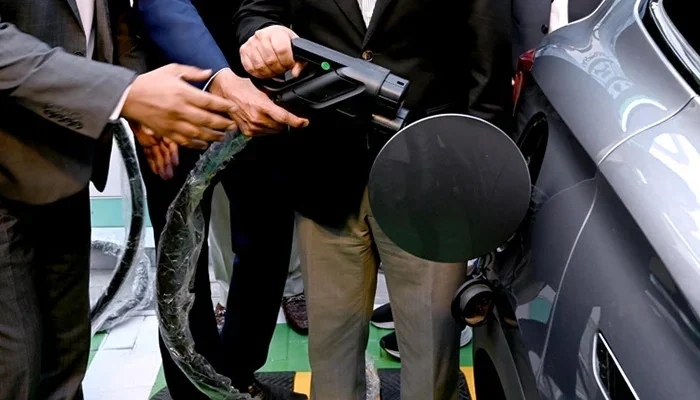
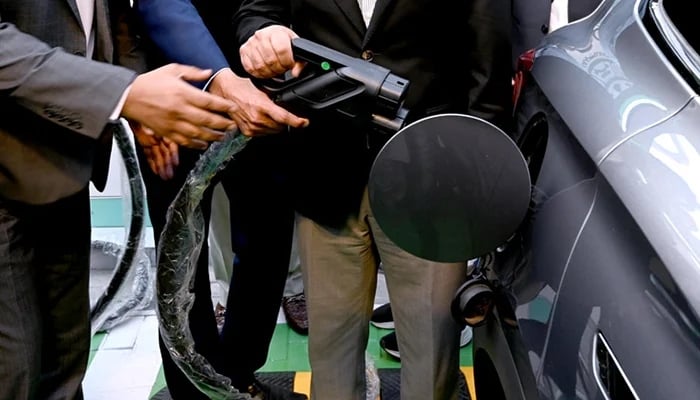
Islamabad has emerged as one of the first cities where these efforts are beginning to take shape. The Capital Development Authority (CDA) has introduced measures to expand charging infrastructure, while electric buses are already operating on several routes in the capital. Urban planners believe Islamabad’s planned road network and relatively shorter travel distances make it an ideal city to test large-scale electric mobility. Yet experts argue that infrastructure alone will not determine success.
According to Ahtasam Ahmad, energy finance and climate tech lead at Renewables First, an Islamabad-based consultancy, electric vehicles already make financial sense for commercial drivers who spend long hours on the road. “The economics work, but the value shows up over time rather than upfront,” Ahmad says. He explains that although an electric two-wheeler typically costs 50% to 80% more than a conventional motorcycle, the operating cost is significantly lower.
“An EV costs roughly Rs1.5 to Rs2 per kilometre to operate, compared with around Rs6 per kilometre for a petrol bike. For commercial riders covering high daily mileage, those savings accumulate quickly and recover the higher purchase price within the vehicle’s usable life.” Ahmad estimates that commercial riders switching to electric two-wheelers can save between Rs5,000 and Rs8,000 every month, depending on how much they travel. However, he cautions that lower running costs alone are not enough to drive mass adoption.
The question remains, despite the financial ease, many drivers remain hesitant to switch. Drivers cite concerns over battery life, charging availability, financing options, and maintenance. “If my battery runs low during work, where will I charge it? How much time will it take?” one ride-hailing driver asked.
Ahmad says these concerns are reflected across Pakistan’s EV market. “Technology unfamiliarity and range anxiety remain major barriers because charging infrastructure is still limited,” he says. He adds that most electric motorcycles currently rely on graphene-coated lead-acid batteries, which are more prone to faults than newer battery technologies. “The servicing ecosystem is also still developing. Maintenance requires different expertise, and in some cases, servicing an EV can currently cost more than servicing a conventional motorcycle.”
One of the common concerns surrounding electric vehicles is whether Pakistan’s electricity system can support thousands of additional vehicles charging every day. Energy experts argue that EV adoption should not only be viewed as a transport issue but also as part of the country’s broader energy planning.
Manager power markets Abdur Rehman says, “Overall, the grid can support EV growth, but charging policy and distribution-network planning must keep pace with vehicle adoption”. He explained that two perspectives need to be considered to understand the grid proficiency: one is generation capacity, and the other is charging infrastructure.
“At the national level, Pakistan has sufficient generation capacity to accommodate EV adoption in the near term. This is more an opportunity than a threat: grid electricity generation declined from 154 TWh in FY22 to 135 TWh in FY25, amid rapid rooftop-solar adoption. EVs could therefore create productive demand and improve the utilisation of existing power-sector assets.
The challenge lies in the charging infrastructure and the local distribution grid. Pakistan needs an adequate network of home, workplace, and public chargers to make EV adoption practical. Pakistan, therefore, needs coordinated action from the government, regulators, and distribution companies to expand charging access, introduce time-of-use tariffs, and enable smart charging that shifts EV demand to daytime solar hours and other off-peak periods”, he added.
Originally published in The News
2026-07-15 14:47:00
News Source