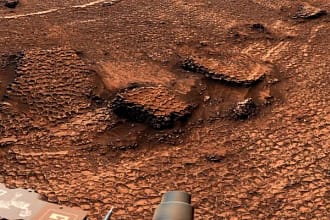



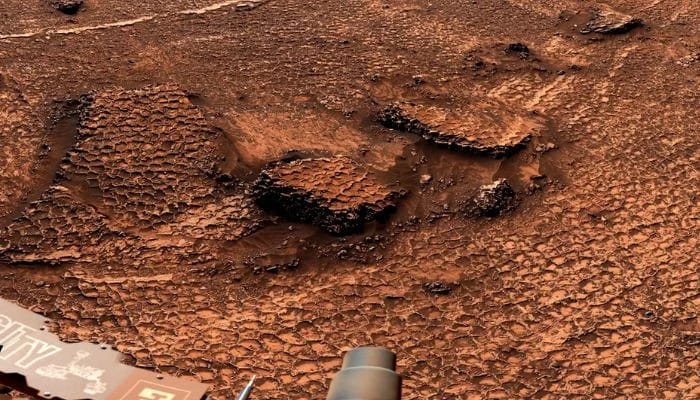
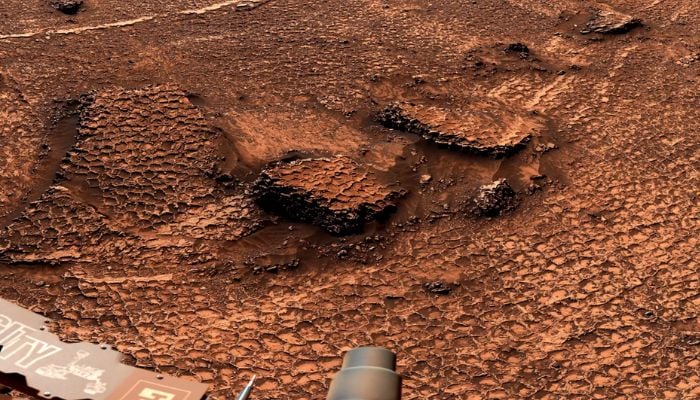
NASA’s Curiosity Mars rover has found a vast field of honeycomb-shaped polygons in a Martian Valley called “Valle Grande.”
This marks the largest concentration of such features ever discovered on the Red Planet.
The rover stumbled upon a 360-degree panorama on June 19 and captured the geometric patterns spreading in all directions. They were even wrapped around a 20-ft-tall butte nicknamed “Miraflores.”
Each polygon measures about 1.5 to 3 inches across.
Project scientists Ashwin Vasavada of NASA’s Jet Propulsion Laboratory said: “We’ve seen a lot of fascinating landscapes through Curiosity’s eyes, but this area of polygons took our breath away. We measured their shapes and chemistry carefully and are hopeful there are clues in the data as to how these features formed.”
Polygonal cracking has been seen before by the mission, though not to this magnitude. Some previous polygons are undeniably mud cracks, indicating periods of both dryness and moisture on the Red Planet. In 2023, the patterns described were termed “first evidence” of seasonal patterns like those on Earth which “enabled molecular evolution and thus the emergence of life.”
There are many ways in which honeycomb shapes can be produced, either through cycles of heating and cooling or through compaction, which squeezes water from the sediment. It is not yet known which process formed the polygons in Valle Grande.
The discovery comes as Curiosity continues its ascent of Mount Sharp, a 3-mile-tall mountain the over has been climbing since 2014. Billions of years ago, lakes and streams dotted the mountain’s lower foothills.
2026-07-31 00:29:00