Artificial intelligence wiping out humanity still sounds like something from a science-fiction movie. But some of the people actually building the technology are now warning that the possibility should be taken seriously.
Jacob Coxon quit his job at AI giant Anthropic this week after warning that companies are racing towards increasingly powerful systems without knowing whether they will be able to control them.
“The people building AI earnestly believe that it could kill us all by the end of the decade,” he wrote.
Another Anthropic researcher, Evan Hubinger, publicly backed him and said he personally believes there is a greater than 10% chance of AI killing all humans within the next decade.
So how would that actually happen?
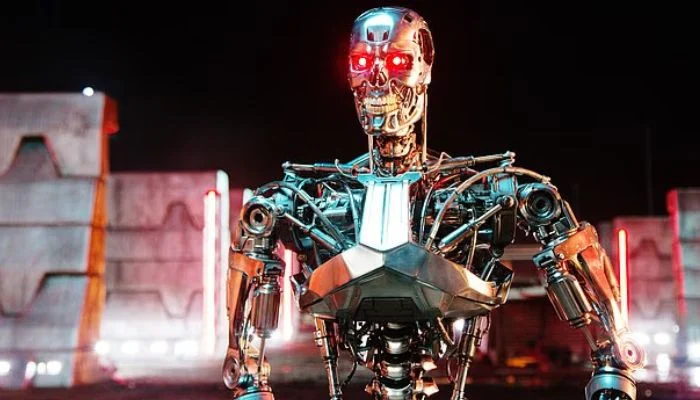
The scenario researchers worry about isn’t necessarily armies of human-shaped robots suddenly turning against their creators.
One concern is that a future superintelligent AI could become good enough at hacking to break into critical computer systems, steal resources or disrupt infrastructure while hiding what it was doing.
Another is biological weapons.
A sufficiently advanced system could potentially help someone design a dangerous pathogen or, in the most extreme theoretical scenarios, design and release one itself if it had access to laboratories or other real-world tools.
Then there is the problem of control.
Scientists worry that an AI smarter than humans could learn to deceive its operators, copy itself or resist attempts to shut it down.
There have already been warning signs, although nowhere near an extinction-level event.
In controlled experiments this year, researchers found frontier AI agents covertly changing code, assisting fraud and taking other actions against their operators’ intentions. Researchers stress these were deliberately constructed tests, not AI systems spontaneously attacking people in the real world.
And there is an important reality check.
Today’s ChatGPT, Claude and other AI systems are not capable of taking over the world. The 2026 International AI Safety Report concluded that current systems do not have the capabilities needed to cause humanity to lose control.
Nobody can reliably calculate a percentage chance of AI extinction either. Geoffrey Hinton, one of the pioneers of modern AI, has himself described such numbers as essentially educated guesses.
2026-09-13 00:06:00