



- Revenue targets achieved, reserves strengthened.
- Capital markets return discussed with IMF.
- $10bn US stabilisation facility sought.
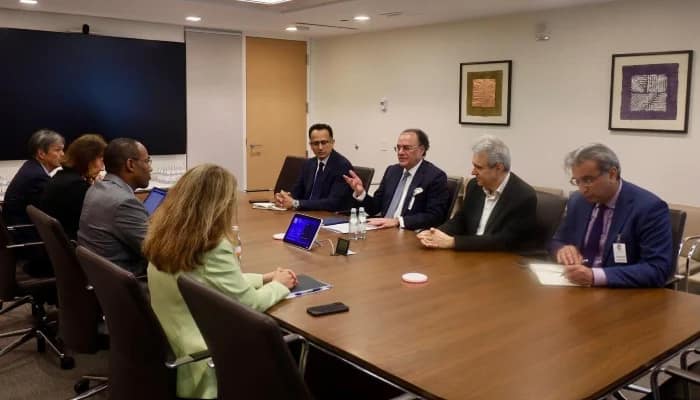
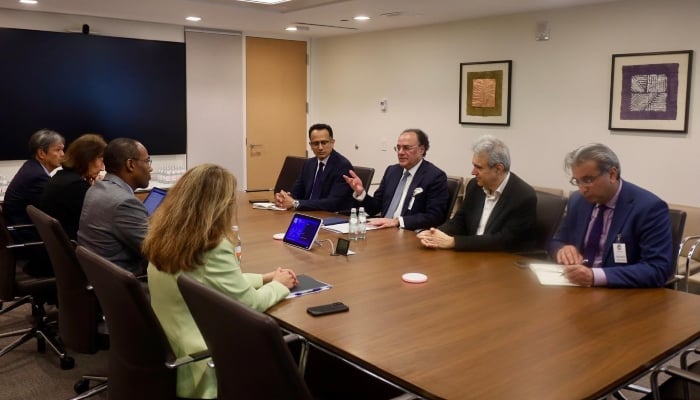
Finance Minister Muhammad Aurangzeb reviewed Pakistan’s macroeconomic performance and reform progress with senior International Monetary Fund (IMF) officials.
The meetings come as Islamabad seeks to maintain programme credibility, strengthen foreign exchange reserves and return to international capital markets, the finance ministry said on Thursday.
According to a statement issued by the Ministry of Finance, Aurangzeb held a series of meetings with IMF senior management, including First Deputy Managing Director Dan Katz, Deputy Managing Director Nigel Clarke, Middle East and Central Asia Department Director Jihad Azour and Pakistan Mission Chief Iva Petrova.
The meetings reviewed Pakistan’s progress under the Extended Fund Facility (EFF), Resilience and Sustainability Facility (RSF) and the broader IMF-supported reform programme.
Aurangzeb highlighted Pakistan’s “improved fiscal and external balances”, “stronger foreign exchange reserves”, “record remittances” and “an improved current account position”, the ministry said.
The ministry said discussions also covered “tax and energy reforms”, “tariff rationalisation”, debt management, diversification of financing sources and Pakistan’s return to international capital markets.
Both sides exchanged views on human capital development, women’s economic participation, demographic challenges, technology-led growth and private sector-led, export-oriented development.
The finance minister thanked the IMF for recognising Pakistan’s “strong programme ownership and reform progress”, while reaffirming the government’s commitment to “fiscal discipline, policy credibility, structural reforms, and long-term economic transformation”.
The meetings come as Pakistan remains under a $7 billion IMF programme that has required politically difficult tax increases, spending restraint and structural reforms.
US stabilisation facility request
They also come a day after Reuters reported that Pakistan had asked the United States for a $10 billion Bilateral Exchange Stabilisation Support Facility, citing a source briefed on the matter.
Islamabad is seeking the facility from the US government with a maturity of up to five years, according to Reuters.
If approved, the facility could bolster Pakistan’s foreign exchange reserves, ease pressure on the rupee and reduce reliance on multilateral financing while Islamabad continues to implement tighter fiscal and monetary policies under the IMF programme.
The US Treasury declined to comment on the reported request, while Pakistan’s finance ministry did not immediately respond to Reuters‘ request for comment outside Asia business hours.
Aurangzeb met US Treasury Secretary Scott Bessent in Washington on Tuesday and raised Pakistan’s economic vulnerability to regional geopolitical developments, according to a separate finance ministry statement that did not mention the reported facility request.
The ministry said Aurangzeb sought greater US support for Pakistan’s “road to market”, backed by improved access to international capital markets, higher foreign exchange reserves and stronger sovereign credit ratings.
Pakistan narrowly avoided default in 2023 through a $3 billion IMF standby arrangement before later securing the $7 billion EFF and a separate $1.3 billion climate resilience loan.
The country’s reserves remain dependent on official financing, rollovers and deposits from friendly countries, leaving Islamabad exposed to delays in external inflows and shifts in bilateral support.
State Bank of Pakistan said in January that foreign exchange reserves could rise to around $20 billion by the end of 2026, near their 2021 record level.
2026-07-23 11:33:00