
“Achieving a lasting peace is hard but achievable if everyone makes best efforts,” says Board of Peace High Representative Nickolay Evtimov Mladenov about Gaza.
This one sentence by an accomplished Bulgarian politician who served his country as Minister of Foreign Affairs (2010-2013) and Minister of Defence (2009-2010) before taking charge as the United Nations Special Coordinator for the Middle East Peace Process (2015-2020), sums up his current task assigned by President Donald Trump.
Mladenov is lauded for his courage to squarely blaming Israel for continuously breaking ceasefire by killing 18 ‘civilians’ on 2nd August and destroying ‘medical supplies’ that Palestinians depend on.
Peace envoy lamented that the Israeli bombardment had come at a time when he and his team were working around the clock to de-escalate and create the space for the full implementation of the president’s plan.
“This comes after intense efforts by the Board of Peace and the mediators [Egypt, Turkiye, Qatar and the US] to bring the Palestinian factions in Gaza to agree to a roadmap on the full implementation of President Trump’s plan, to hand over civilian governance and to decommission their weapons,” the envoy stressed.
As per Palestinian media, since the framework agreement is announced, no days has passed without a bombing by Israel.
For analysts who keep an eye on the region, this is exactly what has hindered peace in the Middle East and resulted in the cycle of violence. They cite the very reason for the failure of the ‘Road Map for Peace’, introduced in 2003, by another Republican President George W Bush.
So, what can make a difference this time around? As per Mladenov, “Both parties must carry obligations under the Comprehensive Plan and the Sharm El Sheikh deal.”
Last week, President Trump had announced that under his leadership, the Peace Board secured a commitment from the Palestinian factions that they would disarm if Israel withdrew troops from Gaza.
However, Israel’s National Security Minister Itmar Ben-Gvir rejected the proposal by terming it unacceptable. He instead stressed for continued targeted killing in Gaza and emigration of Palestinians till Israel declares victory.
“A commitment to stop the targeted killings of the terrorist organisation’s murderers is tantamount to agreeing to allow Hamas to prepare for the next massacre,” remarked Ben-Gvir without mentioning how he envisions total victory.
The Middle Eastern mediators are quite vocal about Israel’s approach to this crisis. Qatar, Egypt and Turkiye have issued a joint statement expressing their “strong condemnation and denunciation” of ongoing Israeli violations of ceasefire in Gaza.
Turkiye blames Prime Minister Benjamin Netanyahu for “undermining USA”. “It has now become more imperative for the international community to adopt a more determined, consistent and firm stance against Netanyahu’s expansionist and militarist mindset, which seeks to turn the Middle East into a zone of perpetual conflict,” outlined Ankara.
Qatar urged the international community to pressure Israel to end ongoing violations of Palestinian rights and ensure the roadmap is fully implemented.
Egypt insists that Israel must withdraw from Gaza and allow humanitarian assistance to Palestinians.
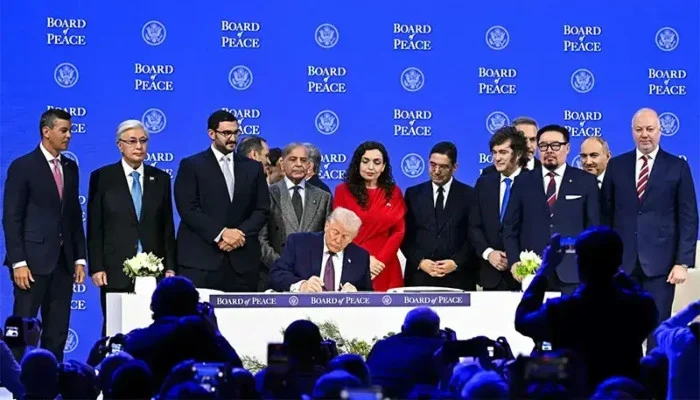
It is the United States of America that showed a ray of peace on the horizon. Proposed in September 2025, President Trump’s Board of Peace was praised by a range of countries as they believed it would “set the framework, and coordinate funding for the redevelopment of Gaza”.
The founding members of the board include USA, Israel, Saudi Arabia, Egypt, Qatar, Turkiye, Bahrain, Jordan, Kuwait, UAE, Pakistan and Morocco. Others include Albania, Argentina, Armenia, Azerbaijan, Belarus, Bulgaria, Cambodia, El Salvador, Hungary, Indonesia, Kazakhstan, Kosovo, Mongolia, Paraguay, Uzbekistan and Vietnam.
This list is expected to grow. However, some major countries have criticised Board of Peace as an imperial structure created to undermine the United Nations.
The United Kingdom and members of the European Union have expressed fears that it may undermine the United Nations, give sole veto power to President Trump and incite conflict with national constitutions and international laws.
Similar reservations were expressed by the world’s smallest but a significant country, The Vatican City.
Brazil and Mexico distanced themselves citing Palestinian absence as a reason while India was envy of Pakistan’s mighty presence in the board and fearing the risk of foreign mediation on Indian Occupied Jammu and Kashmir (IIOJK).
Veto power wielding nations China and Russia went a step ahead. They remained absent as the board was recognised by the United Nations Security Council. That resolution 2803 (2025) endorsed an International Stabilisation Force in Gaza till 2027.
China stressed for multilateralism and vowed to remain committed to safeguarding the UN-centered international system. Fu Cong, China’s permanent representative to the United Nations criticised the text by saying that, “The draft resolution is vague and unclear on many critical elements.”
President Putin, initially expressed willingness to contribute $1 billion from Russian assets frozen in the US to secure permanent seat on the Board of Peace. However, he hasn’t accepted the offer as yet.
Explaining the reason for abstention, the Permanent Representative Vassily Nebenzia said that the resolution failed to mention Israel’s obligations, the role of UNRWA, the situation in the West Bank and East Jerusalem, or the universally recognised two state solution.
“Six months after the vote on Security Council Resolution 2803, the so-called ‘Trump Plan’ remains largely a dead letter, with declarative successes only serving as a smokescreen to conceal the grim reality in the Gaza Strip,” remarked Nebenzia.
It is evident that Russia and China are also concerned about the larger role the Board of Peace intends to play in future. After all, its charter didn’t mention Gaza. Instead, it vows “to promote stability, restore dependable and lawful governance, and secure enduring peace in areas affected or threatened by conflict”.
Hence, Beijing and Moscow see the board of peace gradually adopting the role of the United Nations where these two countries wield veto powers. Becoming toothless under the leadership of the United States and at the disposal of its Chairman President Trump is not a good option.
A number of diplomats say that by ensuring peace in Gaza and realising the two-state solution, President Trump can make a solid foundation for the Board of Peace Charter.
If true peace for Palestinians is not realised, China and Russia may continue to push Shanghai Cooperation Organisation (SCO) and Commonwealth of Independent States (CIS) to widen their influence or jointly come up with something similar to Board of Peace.
The author is Controller News at Truth Wire. He posts on X at @NasimHaider2 and can be reached at [email protected]
2026-08-04 19:42:00