- Rescuers used drilling, blasting and heavy machinery to clear tunnels.
- Rain repeatedly refilled excavated sections with water, delaying rescue.
- Rescuers eventually detected noises from tunnel and located survivors.
NUWAKOT/KATHMANDU/UPPER TRISHULI 3A HYDROPOWER STATION: A delirious Kabir Maharjan drifted in and out of consciousness in a pool of muddy water in complete darkness, trapped for nine days in a tunnel beneath the wreckage of Nepal’s worst flood disaster in decades.
When he finally awoke at a hospital after a miracle rescue, he did not recognise his wife. Confused, he asked her why she had not given him a bed sooner.
Maharjan was one of hundreds of hydropower workers believed to have been buried when a glacier collapsed above Nepal’s Trishuli valley on August 26, unleashing a wall of mud and water that killed more than 1,300 people and left thousands missing across Nepal and neighbouring Tibet.
He and mechanical foreman Sanjay Sah survived in an air-filled chamber, said legislator Shri Ram Neupane, a veteran tunnel engineer who helped lead the rescue effort.
Their rescue against the odds has given hope to search teams working at the sites along the devastated valley that some of the 121 workers still believed to be trapped in tunnels as of Monday are still alive.
Reuters has reconstructed the full story of the men’s survival and the frantic effort to save them through exclusive interviews with a dozen people, including the previously unreported accounts shared by relatives, engineers, government officials and rescuers directly involved in the operation and a review of site documents, maps, and internal conversations between rescuers.
The morning
At 7:30 am (0145 GMT) on the day of the disaster, Maharjan called his wife before his shift at the Upper Trishuli 3A hydropower project.
“I have to go inside the tunnel,” he told her. “There won’t be any network inside.”
Around 60 minutes later, a glacier collapsed at the Langtang Lirung mountain some 25 miles upstream, causing a landslide so powerful that it formed a wall of water that flattened villages and submerged a network of 12 hydropower projects with nearly 900 workers inside.
In the capital Kathmandu, electricity department officials were monitoring the projects’ power supplies on their screens. Then the fields started going blank — one after another, stations disappearing from the control panels, falling like dominoes.
Suraj Dahal, an engineer at the Nepal Electricity Authority who led parts of the rescue effort, said he was not immediately alarmed because “floods are normal” in Nepal.
They soon understood otherwise. Because the 3A station manager was abroad, it took officials two extra minutes to reach out on call to the roughly 40 workers estimated to be inside. By then, at least two hydropower projects upriver had already been hit.
At 9:15 am — two minutes after Maharjan’s wife, Hira Shova Maharjan, had tried and failed to reach him — officials gave the final order to 3A: “Evacuate!”
Sah, who worked in the power house’s control room, sped from floor to floor, warning colleagues individually, he later told rescuers.
Outside the tunnels, evacuating workers tried to run away from the flood, but were not fast enough. Officials pointed to footage showing a group of roughly 30 workers swept away by a wave many times their height.
Rescuers later identified an escape ladder which, had workers known of it, could have saved as many as two-thirds of those inside, said Dahal.
But they “didn’t know where to go,” he said.
Of the tunnel’s four access routes, engineering drawings seen by Reuters showed one ran more than 180 metres to the underground powerhouse — but rescuers believed it was fully flooded, offering no hope of survivors.
Neupane instead turned his attention to a shorter cable-duct tunnel that sloped upward and was less exposed to the floodwaters. It was there that Maharjan and Sah had taken shelter, just 160 metres from the exit — “at the corner, at the edge of the tunnel,” as Maharjan would later describe it to his wife.
Fear of the worst
For the next nine days, the air pocket that had saved their lives became their prison. Sah said he recited Hindu prayers to keep his courage. Maharjan sipped the same muddy water he slept in to stay alive, his wife said.
When Hira Shova first heard about the flood, she assumed the powerhouse would be safe.
She tried calling her husband, colleagues, anyone who might know something. No one answered.
When officials later showed her photographs of where the site entrance once stood — now a bare riverbank — she told herself, “he couldn’t possibly be alive”.
“Deep down in my heart, a terrible hopelessness was setting in,” she recalled, but to her sons, 15 and 10, she kept up a brave front.
Race against the mountain
Officials believed that oxygen pockets scattered through the wreckage might help some workers survive.
With more than 7,500 houses destroyed across the valley, according to Dharam Raj Uprety, chief of Nepal’s National Disaster Risk Reduction and Management Authority, rescuers had to make brutal triage decisions about where to dig first. But 3A ranked near the top of the list because officials hoped its multi-storey structure of turbines and ventilation floors might have trapped pockets of air.
Legislator and engineer Sagar Dhakal, along with Neupane, reached the site by army helicopter the day after the disaster. They found heavy machinery couldn’t move in immediately; the debris was too saturated.
“Everything you drop on that place just goes under,” said Prakash Pokhrel, a geologist with Nepal’s disaster management authority.
Crews first had to build a stable platform before any excavation could begin.
Serious digging didn’t start until three days after the disaster. All four tunnels were blocked — mud, rock, timber and debris, some of it buried under 15 to 30 metres (49 to 98 feet) of landslide material. Rescuers turned to drilling, controlled blasting and heavy equipment to inch a path forward.
A breakthrough came when a 5-inch borehole drilled from above finally confirmed the tunnel’s true alignment, giving crews a fixed point to dig towards.
Rain made everything worse. Several nights, downpours refilled the excavated shaft with fresh water and debris, undoing hours of work in minutes. It took rescuers nearly six days just to reach the tunnel’s buried entrance, said Amshu Kiran Shahi, a board member of the Nepal Electricity Authority. When they called out for survivors, nobody answered.
The breakthrough
The night before the survivors were found, rescuers hit a wall of mud-clogged debris they couldn’t move. Dhakal’s crew improvised, tapping a natural channel some 15 metres above the tunnel and forcing water through it with a high-pressure jet that cleared 4 to 5 metres in minutes during testing.
Then the rain came again, triggering a partial collapse that briefly trapped several rescuers themselves. The operation stalled for hours before colleagues talked them back inside, and crews reinforced the passage with metal sheeting and gabion wire.
At 4 am on the 10th day, Dahal got a call from a heavy equipment operator: the rescuers had heard something. A noise. Maybe a survivor. Maybe just an echo of the rescuers’ own voices calling into the dark.
On the ground, Ganga Baral, who led the rescue team, said they began to hear noises as they drilled into the tunnel.
Again and again, they cut their machines’ engines to listen. “We would call out, ‘Where are you? Are you there?'” Baral said. “Sometimes it felt like there was a person alive trying to communicate with us.”
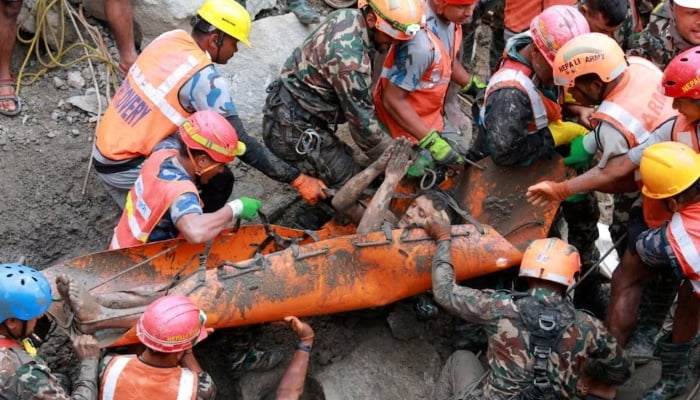
They still couldn’t make out words — but they now estimated the source was just 15 to 20 metres away. Then, in the beam of a light, they saw a hand.
Another 5 to 10 metres of mud-choked passage stood between them and the survivor. By 7 am, soldiers broke open a small hole.
From inside came a single word: “hunuhuncha”, which loosely translates to “we are here”.
Into the light
Neither man could stand when rescuers finally pulled them from the tunnel. Sah, his face caked in mud, had to be carried out on a rescuer’s back. He managed to lift one hand towards a camera. Maharjan, with more severe injuries, went out on a stretcher.
“Mummy, Papa is back!” his sons shouted when they heard.
Dhakal, who ran the operation from outside but never entered the tunnel himself, wept when the two men emerged. “I couldn’t hold my tears,” he said.
The following day Chinese national Lu Haitao was found in the tunnel of a separate station, the Upper Trishuli-1 Hydropower Project.
At the hospital, doctors operated on a deep, infected wound on Maharjan’s leg, his wife said.
When Hira Shova walked into the hospital room, he did not recognise her.
“Where am I?” he asked her.
But she was just thrilled to get him back alive.
“He is blessed with another life.”
2026-09-08 06:33:00