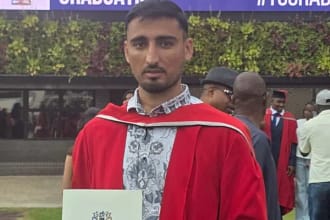



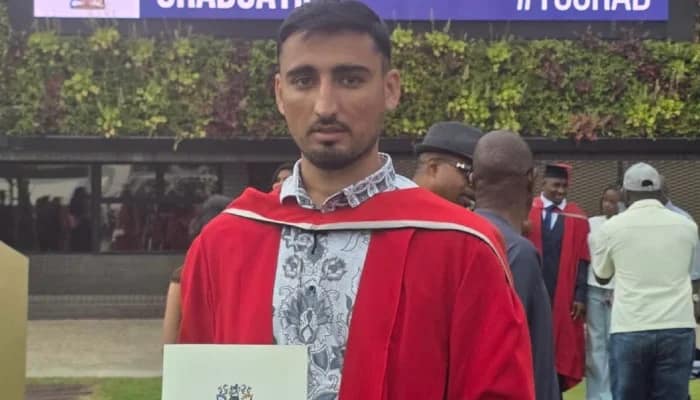
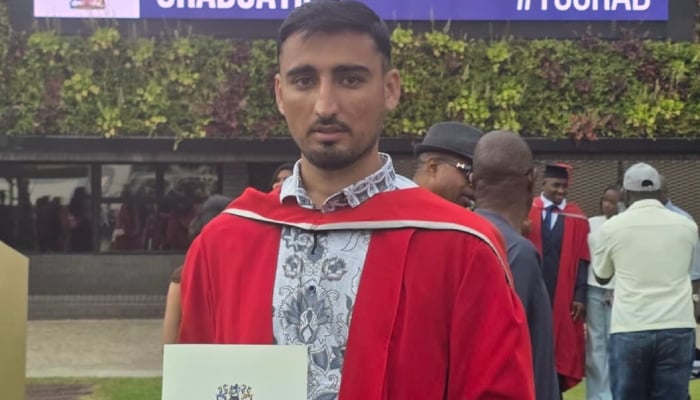
Kamran Hayat’s photo took me back twenty years. This courageous young man from North Waziristan sent me his picture after earning an MSc in Accounting and Finance from a university in the UK. Twenty years ago, when his journalist father, Hayatullah Khan, was abducted from North Waziristan, Kamran was only four or five years old.
Journalists held many demonstrations in Peshawar and Islamabad demanding Hayatullah Khan’s recovery. At one such protest, little Kamran stood holding a placard alongside his elder sister and younger brother. The placard read: “Free journalist Hayatullah of North Waziristan.”
Before his abduction, Hayatullah had told me and several other journalists in Islamabad that if anything happened to him, government agencies would be responsible.
North Waziristan’s political agent at that time kept lying that the Americans had picked him up and that Hayatullah was in Bagram jail.
It was also claimed by some government sources that Hayatullah was an American informant and had been abducted by the Taliban. After six months missing, Hayatullah’s body was found in Mir Ali on June 16, 2006. His hands bore official-issue handcuffs and he had been shot in the head — it appeared that he tried to escape from some detention centre but he was shot from behind.
On June 19, 2006, I wrote in my column in Daily Jang that Hayatullah Khan’s only crime was exposing American drone strikes in the tribal areas. Initially, the government claimed these strikes were accidents and terrorists killing themselves while making bombs. Hayatullah brought forward photographs of Made-in-USA missile fragments used in these drone strikes.
When these pictures were published in different newspapers, some government spokespersons were proved wrong. After bringing the truth to light, he was summoned by a government official in North Waziristan and was told to leave either North Waziristan or journalism altogether. He was even offered a government job. He came to Islamabad and told me about the pressure. I asked him not to worry and assured him we were standing behind him. He went back to North Waziristan and refused to accept a government job. After a few days, he was abducted.
We held a demonstration outside the Parliament House Islamabad and demanded a judicial inquiry to investigate the assassination of our journalist colleague. Aftab Khan Sherpao, then interior minister under the Musharraf government, formed a judicial commission after negotiations with us.
Before this commission, Hayatullah’s wife wanted to name those responsible for her husband’s abduction — names Hayatullah himself had given her before his abduction. In November 2007, Hayatullah’s wife was martyred in a hand grenade attack inside their own home in Mir Ali. Kamran and his young siblings were now left without either parent.
Kamran had been attending nursery at Al-Hayat Model School, which his father had built, where his mother taught girls. Educating girls had been a shared dream of the martyred couple.
When Hayatullah built this school in the underdeveloped area of Jungle Khel, he told me: “You know North Waziristan only for terrorism and drone strikes, but I will change my region’s destiny through education.”
With no expectation of justice for the orphaned children and elderly grandparents, Hayatullah’s brother, Ehsanullah, took the orphans to Peshawar for safety.
Little Kamran studied at various schools in Bannu and Peshawar before reaching the boarding section of Modern Age School and College in Abbottabad. The hardships and struggles his displaced family endured during this period are a separate story altogether.
But Kamran continued his educational journey. At Modern Age School, he received the caring attention of teachers like Wahid Mir and Samira Wahid. After completing matriculation and intermediate studies, he earned a degree in Accounting from SBM College, Abbottabad.
With this degree, he could have secured a decent job in some government or private institution. Instead, Kamran chose a harder path — deciding to go abroad for higher education despite limited financial resources.
It was no easy decision, but after considerable effort, he secured admission for an MSc course in Accounting and Finance at Teesside University in the UK. After gaining admission to this university in North Yorkshire, the toughest hurdle was obtaining a visa. Some people said that even if a boy from North Waziristan got a UK visa, he wouldn’t be allowed entry into Britain.
Luckily, Kamran did get his visa. But at Islamabad airport, immigration officials stopped him before his departure to Britain. They couldn’t believe a young man from North Waziristan was heading abroad for higher education.
After lengthy, difficult questioning, immigration finally let him go.
Once in Britain, he had to take a part-time job to support himself. He worked small jobs for some fellow Pakistanis there — who would make him work for a few days and then let him go without paying him. Kamran didn’t lose heart. During this time, Ahmad Nawaz — another courageous young man injured in the Army Public School Peshawar attack in 2014, now at Oxford University — guided Kamran over the phone many times. Through hard work and dedication, Kamran finally earned his MSc degree in Finance & Accounting.
In this photo with a degree in his hands, I don’t just see one young man’s success. I see the success of all of North Waziristan, of Khyber Pakhtunkhwa, and of every oppressed person in Pakistan.
This is the victory of courage and resilience over terrorism. Kamran Hayat, who lost both his parents in childhood, has shown the whole world through his hard work that North Waziristan is not only about bomb blasts and target killings.
If the youth of North Waziristan are given the proper opportunities and resources, they can bring honour to their country in every field, including education. The state has still not given justice to Kamran Hayat, but instead of seeking revenge against the state, Kamran Hayat has brought honor to the state abroad by passing with distinction.
The important question now is: should Kamran return to Pakistan after completing his higher education? Is today’s Pakistan safer than the Pakistan of twenty years ago? If Kamran returns to Pakistan and travels to Mir Ali to pray at his parents’ graves, can he safely return to Islamabad? These are the questions Pakistan’s rulers should reflect upon.
Our people in power today proudly boast of great achievements, but can they guarantee that if Kamran Hayat returns to Pakistan, nothing will happen to him in North Waziristan like what happened to his parents?
Recently, Malala Yousafzai visited Pakistan very quietly due to security concerns. She moved with a lot of security, but Kamran doesn’t have any security. Why has this state failed to bring peace and justice to North Waziristan over the past twenty years?
Hayatullah Khan wanted to change his region’s destiny through education. Kamran’s success is the beginning of the fulfillment of that dream. I am certain that one day Kamran Hayat will return to Pakistan.
Whether or not Kamran finds peace and justice, he will keep chasing the dream his father Hayatullah once saw. Kamran has succeeded — through education, North Waziristan will succeed too, and one day Pakistan will succeed as well. Our next generation will surely see this picture of success. This generation will defeat the forces of darkness through the light of education.
2026-07-23 13:37:00