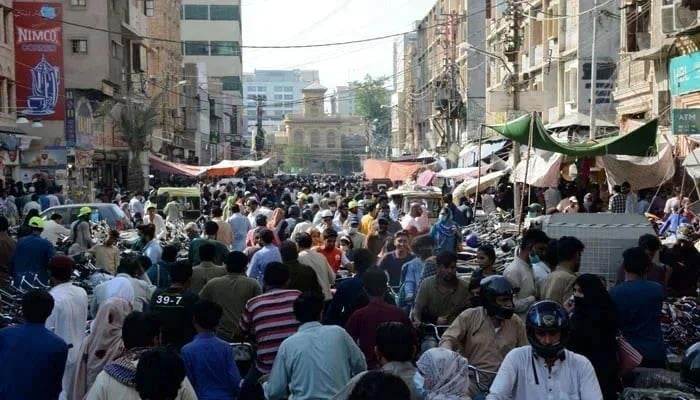
On July 11, the world observed World Population Day. The day is very important because the world population is more than 8.3 billion. It is particularly relevant to Pakistan, which has one of the fastest-growing populations in the world.
Pakistan’s population, according to the 2023 Population and Housing Census, is approximately 241.5 million, up from 207.7 million in 2017. The average annual population growth rate between the two censuses was about 2.55 per cent, double the rate recorded in the last intercensal period. At this rate, millions of people are added to the population every year.
Pakistan is also quite young. About 26 per cent of the population is between 15 and 29 years of age, while about 67 per cent of them are below 30. Currently, more than 40 per cent of the population is below 15, meaning a large generation will soon enter higher education, the labour market and reproductive age.
The challenge is even more acute with recent demographic projections. Depending on how quickly fertility declines, the population might be estimated between 372 million and 390 million by 2050. Some international models put it even higher. The difference between these scenarios is not just statistical. It means thousands of new classrooms, jobs, houses, hospital beds, water connections and public transportation trips that the country may need to pay for in just one generation.
It is also a fact that this staggering population growth is already beyond the capacity of most public institutions. Each year, more children enter schools than the system can handle, resulting in over 26 million out of school. Existing classrooms are overcrowded and teachers, learning materials, sanitation facilities and safe buildings are not available. Meanwhile, the health system is responding to an increasing number of mothers, infants and children, often in the absence of basic health units and hospitals.
Likewise, urban centres are growing faster than planning systems can keep pace with. Karachi, Lahore, Rawalpindi, Peshawar, Quetta and other secondary cities are facing a growing demand for affordable housing, drinking water, sewerage, waste management, roads, and public transport. In all places, infrastructure fails to keep pace, informal settlements expand, groundwater is depleted, untreated waste enters rivers, and low-income families become concentrated in dangerous locations.
Population dynamics are also related to climate change – though we are at a very low greenhouse-gas level, less than 1%, and suffer from extreme heat, floods, droughts, glacial melt, water scarcity and food insecurity. So, more people mean more homes and more lives at increased risk of climate-induced hazards. And more people mean more demand for water, food, energy, land and construction, putting more pressure on an ecosystem already under siege from climate change.
This rapid and unplanned urbanisation can push families into floodplains, unstable slopes and heat-prone settlements. On top of that, population pressure has dramatically accelerated deforestation, groundwater extraction, waste generation, and the conversion of agricultural land into housing societies and settlements.
The same pressure is on the employment market. The current and future governments will bear the weight of creating tens of millions of jobs over the next decade just to absorb the new entrants. Failure to do so would increase unemployment, informal work, outward migration, cohesion issues and social frustration. A young population is not necessarily a demographic dividend. It is only when young people are healthy, educated, skilled and productive.
Aided by a Supreme Court-backed process, the Council of Common Interests (CCI) made key recommendations in 2018 to reduce population growth, lower fertility, and expand family planning and reproductive healthcare services. This included the creation of national and provincial task forces, the provision of family-planning services through public health facilities, more Lady Health Workers, male engagement, public-awareness campaigns, reliable data systems and more effective co-operation with civil society.
A National Action Plan on Population for 2019-2025 that puts this into practice in terms of responsibilities, timelines and funding. The plan also called for a special, non-lapsable population fund. Another revised National Program for 2025–2030 set ambitious targets: raising the contraceptive prevalence rate to 60%, reducing the total fertility rate to 2.2 children per woman and lowering the population growth rate to 1.1% by 2030. But the real progress on action plans is still out of sight.
Pakistan has also made commitments under the global FP2030 partnership. The commitments can be translated into action only if the population welfare departments across provinces ensure that family-planning and birth-spacing services are linked to maternal and child healthcare through community health workers, by launching robust digital information services and helplines that reach women facing geographical, financial or social barriers.
Another imperative is the relevant legal reforms. Over the years, some major steps have been taken by the provincial governments, such as the Sindh Child Marriage Restraint Act 2013, which set 18 as the minimum age for marriage for both girls and boys in the province. Similarly, the Islamabad Capital Territory Child Marriage Restraint Act, 2025, defines a child as anyone below 18.
Likewise, the reproductive healthcare rights legislation in Sindh and Khyber Pakhtunkhwa is a legal basis for access to information and services. Such laws can help to maintain healthy families by delaying early marriage and pregnancy, protecting girls’ education and providing informed reproductive choices. But policy announcements have to be backed by sustained budgets, trained personnel, contraceptive supplies and accountability.
Population planning cannot be viewed as a short-term initiative and should not be placed solely on women’s shoulders. It needs to be framed as a rights-based development agenda that includes health, education, nutrition, gender equality, social protection, employment and local government. The goal should never be coercive population control. It should be for every individual and every couple to make informed and voluntary decisions about marriage, birth spacing and family size. And girls who stay in school, women who are engaged in the economy and families who can afford good healthcare have more power to make such decisions.
In this connection, the provincial population departments’ role remains critical to birth-spacing, reproductive-health outreach, continued contraceptive supply, massive community awareness and meticulous demographic planning. Unfortunately, the departmental performance is compromised by fragmented coordination and capacity gaps, inadequate stock-outs, rural coverage and poor monitoring. Reform should follow workload audits, service mapping and redeployment, not fiscal or job cuts, as we have recently witnessed in Punjab, where thousands of vacancies have been abolished in the population welfare department.
Likewise, the demographic data needs to be incorporated into climate-risk assessments, urban plans, water policies and disaster-preparedness plans. Pakistan still has a window of opportunity. By investing in young people, encouraging voluntary family planning, enforcing protective laws, empowering women through education, bringing real efficiency to governance and integrating population planning with climate resilience and holistic development planning, the country can turn population pressure into human progress.
The writer is a climate governance expert. He can be reached at:[email protected]
Disclaimer: The viewpoints expressed in this piece are the writer’s own and don’t necessarily reflect Geo.tv’s editorial policy.
Originally published in The News
2026-07-14 09:52:00