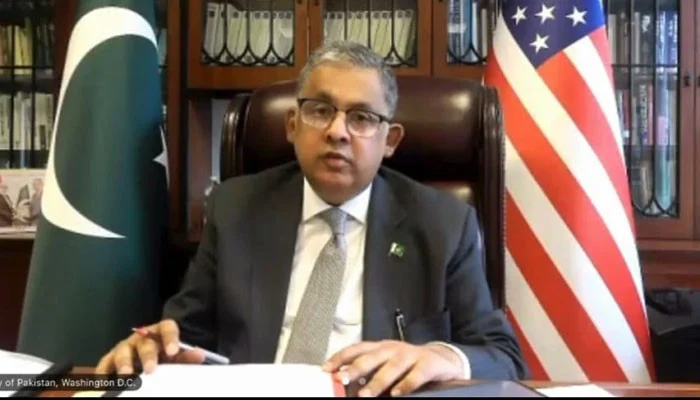

WASHINGTON: Pakistan’s Ambassador to the United States Rizwan Saeed Sheikh has urged adherence to international law in resolving the Kashmir dispute, saying respect for international norms is essential for lasting peace and stability in South Asia.
Speaking at a webinar organised by the Pakistan Embassy in Washington to mark Youm-e-Istehsal, the top diplomat said international law provides the only viable framework for addressing the Kashmir dispute and other regional challenges.
The event, titled “Contemporary Challenges to International Law in South Asia: Jammu and Kashmir Dispute and the Indus Waters Treaty (IWT),” marked the seventh anniversary of India’s revocation of Articles 370 and 35A on August 5, 2019.
Participants reaffirmed Pakistan’s support for the people of Indian Illegally Occupied Jammu and Kashmir (IIOJK) and their inalienable right to self-determination under United Nations Security Council (UNSC) resolutions.

Addressing the webinar, Sheikh said the discussion aimed to examine the legal dimensions of the Kashmir dispute and its connection to the IWT, describing both issues as carrying significant political, economic and geographical implications.
“The only way to govern this kind of situation, which is getting more complicated as we speak, is adherence to international law,” he said, urging India to fulfil its legal obligations and stressing that Pakistan should utilise its growing international credibility to advance its positions on Kashmir and the Indus Waters Treaty.
Messages from President Asif Ali Zardari, Prime Minister Shehbaz Sharif and Deputy Prime Minister and Foreign Minister Senator Ishaq Dar were also read out, reiterating Pakistan’s political, moral and diplomatic support for Kashmiris and calling for a peaceful resolution of the dispute in accordance with international law and UN resolutions.
The webinar featured former UN ambassador Munir Akram, Foundation for American Security and Technology President Ali Unar, Kashmir Civitas Secretary General Dr Farhan Mujahid and Sanober Institute Executive Director Dr Qamar Cheema.
Delivering the keynote address, Akram said Pakistan’s strengthened diplomatic standing and relations with major powers placed it in a stronger position to advocate for the rights of Kashmiris and protect its water interests.
“We have a solid strategic partnership with China, warm relations with the United States, and enhanced international credibility through our diplomatic efforts. Our strengthened diplomatic standing places Pakistan in a strong position to advocate for Kashmir, for justice for the Kashmiri people, and for the protection of our water rights.”
He criticised India’s actions in IIOJK since August 2019 and argued there was no legal basis for placing the Indus Waters Treaty in abeyance.
“India’s strategy on Kashmir has accelerated since August 5, 2019, combining the subjugation of the Kashmiri people with a broader campaign of coercion against Pakistan. India is in open defiance of international law. There is no legal provision allowing the Indus Waters Treaty to be placed in abeyance.”
Akram also called for a coordinated legal and diplomatic strategy involving international organisations, legal experts and countries affected by transboundary water issues.
Dr Mujahid argued that Indian policies in Jammu and Kashmir were aimed at altering the region’s demographic and political identity, while Unar stressed the need to build wider international legal support for preserving the integrity of the IWT.
Cheema warned against the growing risk of “hydro-hegemony” and the militarisation of water resources, saying the treaty remained vital for regional peace, food security, environmental sustainability and long-term stability in South Asia.
The discussion concluded with participants emphasising peaceful and lawful approaches to resolving the Kashmir dispute and safeguarding the Indus Waters Treaty.
Ambassador Sheikh, in his closing remarks, reaffirmed Pakistan’s commitment to supporting the Kashmiri people’s right to self-determination under international law and relevant UN resolutions.
2026-08-06 10:13:00
News Source