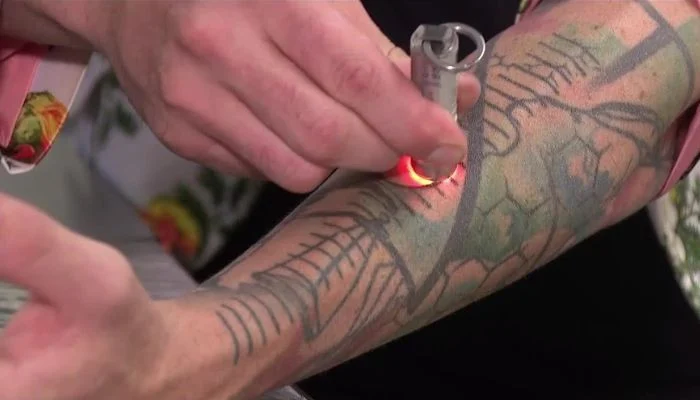
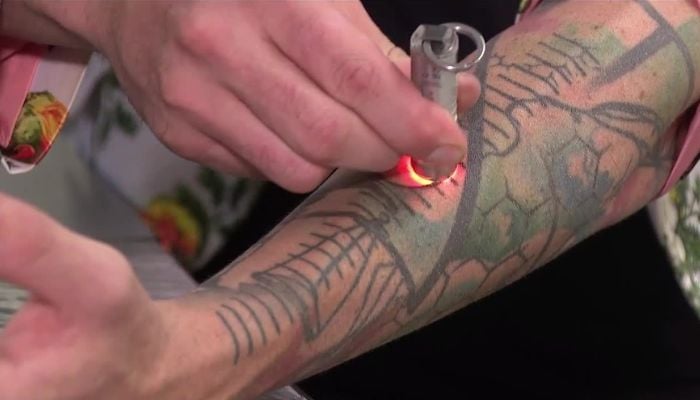
Scientists from the University of Colorado Boulder have created a unique kind of tattoo ink that can be turned on and off via exposure to varying light wavelengths, thus changing the way people look at permanent body art.
This new technology, called PhotoTat, employs photochromic dyes enclosed in nanoparticles of polymethyl methacrylate (PMMA), which is a medical-grade plastic utilised in various implant applications. The ink stays invisible in ordinary light and activates in just seconds upon exposure to ultraviolet light, becoming bright blue, magenta and yellow.
“Think about it as a tattoo that you can have, and whenever you decide you don’t want it to be there anymore, you just turn it off,” explained lead author Carson Bruns, an associate professor of biomedical engineering.
The colours stay visible for hours and even days depending on the lighting conditions but disappear very fast when exposed to strong sunlight.
Bruns tried the inks on himself, giving himself a tattoo in the shape of a fish scale on his leg, which he can change colour using light. Bruns did not have any side effects after more than two years.
The technology would help the medical patients, too. Patients undergoing radiation therapy get tattoos permanently, which could remind them of the trauma; PhotoTat would make the tattoos only visible during clinical visits.
But safety issues still need to be proven. The particular mixture would have to undergo tests for toxicity and sterility separately. The dye also wears off with time due to repeated on-off cycle changes; the wearer would need to apply sunscreen when going out.
Purple ink is now available for $100 per small vial, while others are being developed.
2026-10-10 23:56:00