

Sign In
  • National
  • International
  • Fact Check
  • Research
Truth Wire
  • Home
  • National News
  • World
  • Technology
    • Check out more:
    • Fashion
    • Travel
    • Business
    • National News
    • World
  • Business
  • Entertainment
  • Health
Reading: Scientists dig up Southeast Asia’s largest dinosaur in Thailand
Share
Truth WireTruth Wire
Font ResizerAa
  • World News
  • Pakistan
  • Technology
  • Sports
  • Entertainment
  • Amazing Lifestyle
Search
  • Home 1
  • Categories
    • Technology
    • Pakistan
    • Amazing Lifestyle
    • Entertainment
    • World News
    • Sports
    • Health
  • Bookmarks
  • Sitemap
Have an existing account? Sign In
Follow US
© 2022 Foxiz News Network. Ruby Design Company. All Rights Reserved.
Amazing LifestyleLatest

Scientists dig up Southeast Asia’s largest dinosaur in Thailand

Managing Editor
Last updated: May 14, 2026 2:33 pm
Managing Editor
Share
SHARE

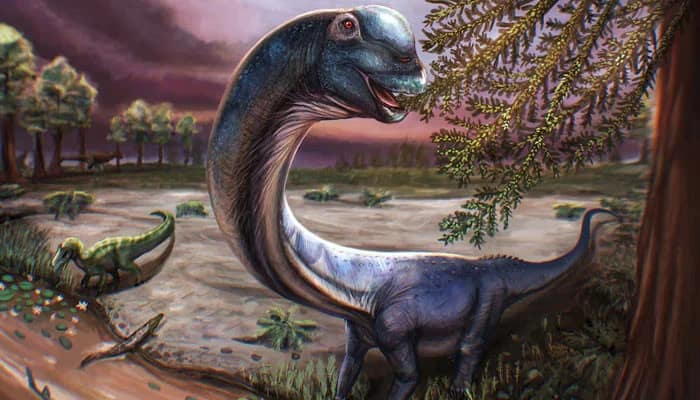
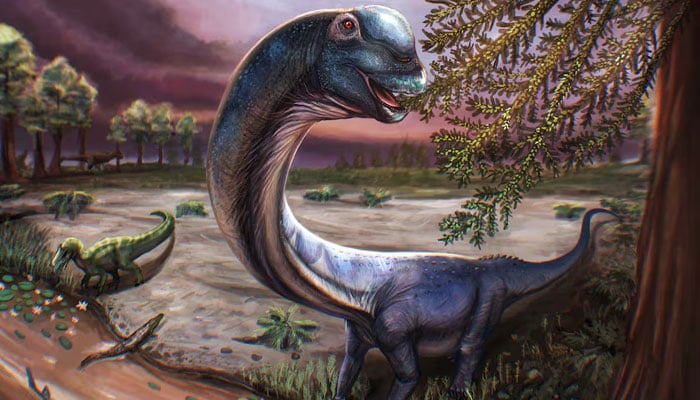
Artist reconstruction of the Cretaceous Period sauropod dinosaur Nagatitan chaiyaphumensis, whose fossils were unearthed in Thailand, seen in this illustration released on May 14, 2026. — Reuters

Along a meandering river in a warm and arid region that is now Thailand roughly 113 million years ago, a plant-eating behemoth almost 90 feet (27 metres) long browsed on the treetops without much fear of predators due to its sheer size.

This was Nagatitan chaiyaphumensis, the largest-known dinosaur from Southeast Asia.

Researchers have unearthed skeletal remains of Nagatitan, a member of the dinosaur lineage called sauropods known for having a long neck, long tail, small head and four columnar legs.
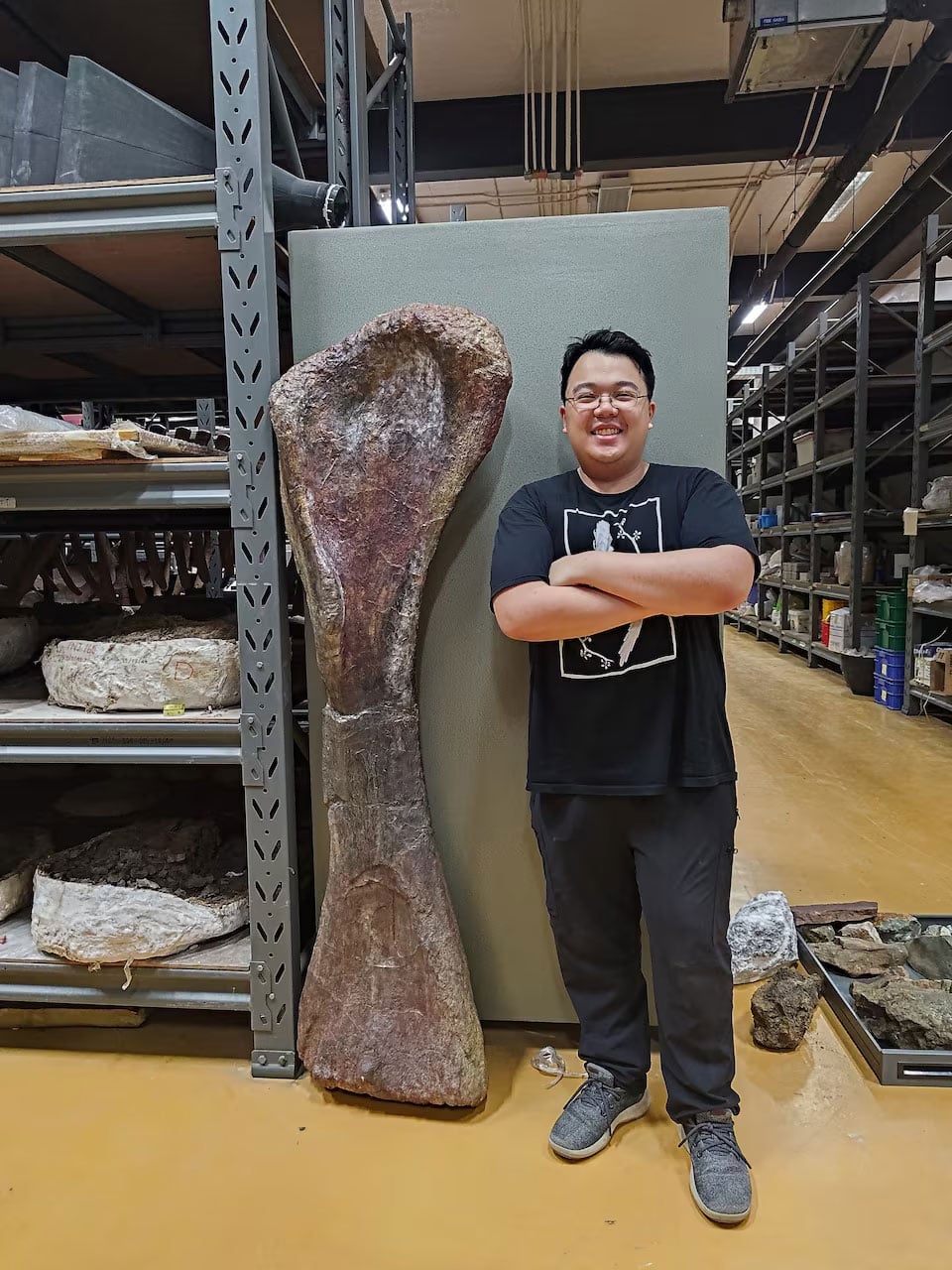
Researcher Thitiwoot Sethapanichsakul poses with a front leg bone, or humerus, of the Cretaceous Period sauropod dinosaur Nagatitan chaiyaphumensis at the Sirindhorn Museum in Kalasin Province, Thailand, in 2024, in a photograph released on May 14, 2026. — Reuters

The fossils of this Cretaceous Period dinosaur were first spotted by a villager in Thailand’s northeastern province of Chaiyaphum. Scientists over a period of years then dug up spine, rib, pelvis and leg bones, including a front leg bone – the humerus – measuring 5.8 feet (1.78 metres) long.

Based on the dimensions of its humerus and femur, the corresponding hind leg bone, the researchers estimated Nagatitan’s body mass at 25 to 28 tons. Its head and teeth were not among the fossils recovered, but the researchers have a good idea of its feeding preferences based on other sauropods.

“Nagatitan was probably a bulk browser that focused on consuming high volumes of vegetation that required little to no chewing such as conifers and possibly seed ferns,” said Thitiwoot Sethapanichsakul, a University College London doctoral student in palaeontology and lead author of the research published on Thursday in the journal Scientific Reports.

The climate was probably subtropical, with some forests, but also savanna-like and shrubland habitats. Nagatitan lived alongside various other dinosaurs as well as flying reptiles called pterosaurs. The rivers were teeming with crocodiles and fish including freshwater sharks.

The ecosystem’s largest predator was a relative of the giant African meat-eating dinosaur Carcharodontosaurus, probably about 26 feet (8 metres) long and around 3.5 tons.

“At that size, it was dwarfed by Nagatitan. At full size, Nagatitan likely had very little to fear in terms of predation,” Sethapanichsakul said.

Predators probably avoided attacking healthy adults of any large sauropod species because of the danger of being squashed. But they may have targeted old or sick adults or vulnerable babies.

“Indeed, sauropods are known to have grown very quickly after hatching, and this probably relates to the dangers of predation. The sooner sauropods could become large, the safer they were because they would have been more difficult to tackle,” University College London palaeontologist and study co-author Paul Upchurch said.

Sauropods included the largest land animals in Earth’s history. Nagatitan was huge by any standard, but not on the scale of some South American sauropods such as Argentinosaurus and Patagotitan that topped 100 feet (30 metres) long.

Nagatitan’s name references Naga, a serpent-like being in some Asian religious traditions that is prominently depicted in various Thai temples. In all, there are 14 named dinosaurs known from Thailand.

The names of several large sauropods include the word titan. Sethapanichsakul said it might be appropriate to call Nagatitan Southeast Asia’s last “titan” because the region became a shallow sea later in the Cretaceous, meaning no more sauropods would live there.

Nagatitan provides insight into sauropod diversity in the region. Not many sauropods are known from Southeast Asia, and Nagatitan is the largest and the geologically youngest of them. Nagatitan belonged to a subgroup of sauropods that possessed bones with lots of internal air sacs and thin walls, traits that lightened their skeletons.

This group originated around 140 million years ago, achieved a global distribution and, around 90 million years ago, became the only sauropods left worldwide, thriving until the dinosaur age ended 66 million years ago with an asteroid impact.

Nagatitan lived at a time when Earth’s atmospheric carbon dioxide levels were climbing, corresponding to high global temperatures.

“Sauropods seem to have become particularly large at this time, with gigantic forms living in South America, China, probably North Africa, and now with Nagatitan, a fairly large one in Southeast Asia,” Upchurch said.

“This possible relationship between large body size and high climatic temperatures is not fully understood, but it’s likely that the high temperatures had an impact on the plant fodder that was important to sauropods, which were very large-bodied herbivores.

Nagatitan gives a glimpse of the period leading up to the eventual peak in body size and temperatures about 10 to 15 million years later,” Upchurch said.


2026-05-14 13:22:00

Subscribe to Our Newsletter
Subscribe to our newsletter to get our newest articles instantly!

Share This Article
Email Copy Link Print
Previous Article PM Shehbaz says US-Iran temporary truce holds but war strains Pakistan economy
Next Article Kylie Jenner surprises fans with unexpected Zelda obsession
Leave a Comment

Leave a Reply Cancel reply

Your email address will not be published. Required fields are marked *

Editor's Pick

The Best Wireless Gaming Headsets in This Year

As for quality, the HS80's provided clear-cut sound with adequate bass and a slight emphasis on the mid-range, making those…

4.8 out of 5Good
5 Tips for Charging an Electric Vehicle More Easily

Politics is the art of looking for trouble, finding it everywhere, diagnosing…

4 Min Read
Google Must Allow Developers to Use Other Payment Systems

Modern technology has become a total phenomenon for civilization, the defining force…

4 Min Read

Top Writers

Oponion

Raducanu beaten by Parry in comeback match after injury layoff

Raducanu beaten by Parry in comeback match after injury layoff…

May 19, 2026

Princess Kate secretly deals with new challenge after health battle

Princess Kate has been slowly easing…

May 19, 2026

Iran stages mass weddings for couples ready for war sacrifice

Iranian authorities held mass public weddings…

May 19, 2026

Air pollution crisis: Moorland burning risks lives of 2.3 in UK

Air pollution crisis: Moorland burning risks…

May 19, 2026

WATCH: Bangladesh players sledge Rizwan during tense Sylhet Test chase

Pakistan's Muhammad Rizwan plays a shot…

May 19, 2026

You Might Also Like

LatestPakistan

NDMA forecasts steady rise in temperatures across country from May 18

A volunteer sprays water on a man to cool off on a hot summer day in Karachi, May 4, 2026.…

7 Min Read
EntertainmentLatest

Phillip Schofield drops bombshell about ‘brutal’ life after scandal hit downfall

Holly Willoughby also cut ties with him, leaving Phillip alone to face media scrutinyPhillip Schofield has spoken his heart out…

8 Min Read
BusinessLatest

After provinces, Centre lifts austerity-driven business-hour curbs until May 31

This undated image shows a large number of people throng Karachi's Ranchor Line Sabzi Bazaar to purchase essential items. —…

7 Min Read
BusinessLatest

Queen rushed to hospital after health scare

Queen Margrethe of Denmark, 86, has been taken to hospitalised after health emergency, a spokesperson for the royal court has…

7 Min Read
Truth Wire

News

  • World News
  • Advertise

Technology

  • Technology

Health

  • Medicine
  • Children
  • Coronavirus
  • Nutrition

Culture

  • Stars
  • Screen
  • Culture
  • Media
  • Videos

More

  • Entertainment
  • Amazing Lifestyle
  • Pakistan
  • Sports
  • Health

Subscribe

  • Home Delivery
  • Digital Subscription
  • Games
  • Cooking
© Foxiz News Network. Ruby Design Company. All Rights Reserved.

Powered by
►
Necessary cookies enable essential site features like secure log-ins and consent preference adjustments. They do not store personal data.
None
►
Functional cookies support features like content sharing on social media, collecting feedback, and enabling third-party tools.
None
►
Analytical cookies track visitor interactions, providing insights on metrics like visitor count, bounce rate, and traffic sources.
None
►
Advertisement cookies deliver personalized ads based on your previous visits and analyze the effectiveness of ad campaigns.
None
►
Unclassified cookies are cookies that we are in the process of classifying, together with the providers of individual cookies.
None
Powered by
Welcome Back!

Sign in to your account

Username or Email Address
Password

Lost your password?

Not a member? Sign Up