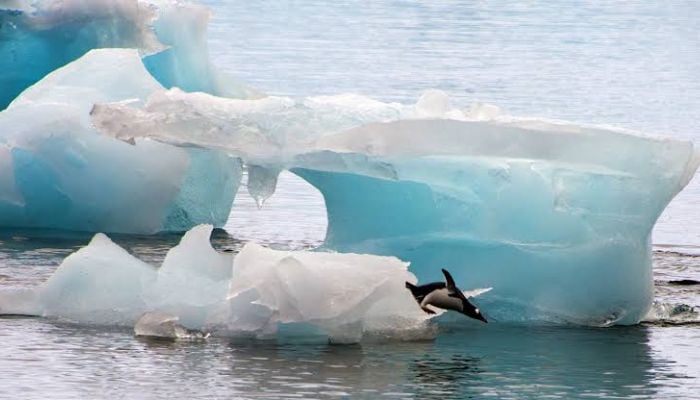
Antarctica has been doing the world a silent favor. For nearly all of recorded history, Antarctica’s ice sheet has served as a massive refrigerator. The ice sheet has trapped toxic substances (pollutants) brought to the continent by wind and ocean current.
Those toxins have settled on the surface of the ice, frozen under layers upon layers of snow and ice. But that agreement is breaking down.
Researchers at the University of Washington have recently published a study in the Proceedings of the National Academy of Science regarding mercury release into the atmosphere from the Antarctic Peninsula, one of the fastest-warming areas of the globe.
The authors explain how they consider mercury release to be part of a “mercury-loop” that includes the atmosphere, glaciers, land and ultimately, oceans. They further argue that increasing global temperature trends and continued atmospheric pollution will work together to accelerate the “mercury-loop,” causing more mercury to be released from melting ice into the surrounding environments than previously thought.
Why this study is unlike so many other studies detailing glacier melting
What separates this story from others documenting glacier melting is the chemical involved, mercury. Once mercury is released into an ecosystem, it does not degrade or dissipate. Instead, it travels through various levels within the food web, accumulating in organisms at each level.
This accumulation is called bioaccumulation. Bioaccumulation is the reason for public health advisories concerning high mercury content in larger fish such as tuna and swordfish.
The food web in the Southern Ocean begins with krill (small crustaceans). All marine mammals dependent on krill for sustenance, including penguins, seals and whales, pass mercury along from the krill as they eat. Researchers have documented measurable amounts of mercury in Antarctic wildlife.
These scientists have utilized feathers from Adelie penguins and other seabirds since the early 2000s as an indicator of pollution levels throughout the continent because mercury bioaccumulates in these birds’ bodies as they feed.
Thus, if glacial melting provides additional sources of mercury entering this food web above those already present in it due to natural processes, then a cumulative increase rather than a single pulse is expected.
Moreover, given that krill represent one of the lower trophic levels in this food web and thus lack mechanisms to remove accumulated mercury, we can expect that higher levels of the food web will contain higher concentrations of mercury.
Feedback loops beyond Antarctica
Scientists have identified an analogous feedback loop occurring in both poles. Researchers studying permafrost thaw in the Arctic have issued warnings about the rapid release of stored mercury into ecosystems.
Both patterns follow the same basic model: warming melts ice but it is not just melting ice that causes pollution to become available again. The more ice thaws, the greater amount of stored materials will be released. As a result, some researchers now use stronger language when describing climate related events than would normally be associated with climate science.
This particular discovery could be viewed as even more problematic for a continent devoid of humans and whose wildlife is extremely remote from human industrial activities. Antarctic wildlife has historically experienced minimal contact with pollutants and therefore lacks significant biological tolerance to them.
Pollutants that undergo degradation relatively rapidly in warmer climates remain stable for extended periods in colder climates. Consequently, mercury released currently is likely to remain active in this ecosystem for a considerable length of time.
Beyond Antarctica
The impacts of this study will not be confined to the Southern Ocean. Seabirds traveling between habitats carry mercury from the southern hemisphere into the northern hemisphere simply by migrating as part of their usual behavior.
Similarly, dissolved pollutants carried by ocean currents will travel beyond the point of origin. For thousands of years, Antarctica’s ice has served as one of Earth’s largest storage systems for hazardous materials.
This study serves as a warning that as the ice disappears, that storage system will begin to give back what it held for thousands of years — but on a schedule that no one controls.
2026-07-29 00:01:00