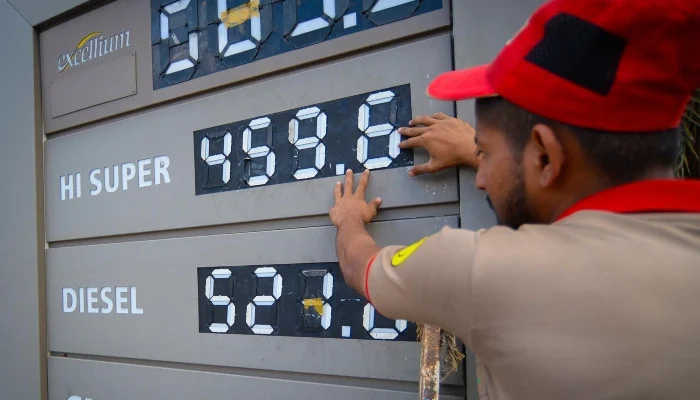
Every minister, adviser and spokesperson will tell you the same thing: Pakistan’s petrol price is based on a rolling Platts/Oilgram average — an objective international benchmark. Transparent. Scientific. Beyond manipulation. Not true.
Pakistan’s petrol pricing formula has a secret. Ministers won’t mention it. Spokespersons may not know it. And Ogra’s weekly notifications are carefully designed to obscure it. The rolling Platts/Oilgram average — that objective international benchmark they keep citing — is not what actually determines what you pay at the pump.
Every minister, adviser and spokesperson will tell you petrol prices in Pakistan are set by an objective international benchmark — the Platts/Oilgram rolling average. Verifiable. Beyond politics. They are telling you half the story. The other half costs you Rs350 billion a year.
Here is the math: 123 million barrels imported per year. An average of $10 per barrel overpaid. Converted at today’s exchange rate. Rs 350 billion. Every year. Gone.
Here is the whole truth: The primary input into Pakistan’s petrol pricing formula is not Platts. Not an independent benchmark. Not a global average. It is a government-owned oil marketing company’s (OMC) own declared import price. The Platts/Oilgram average only kicks in when the OMC’s price is unavailable. That price is almost never unavailable.
The reality: The OMC is Pakistan’s largest oil importer. Its declared purchase price is the primary input into the national petrol pricing formula. It is a state-owned company whose profits flow directly to the government that sets the petroleum levy. It just posted a 149% jump in profits.
Cold truth: The referee is also the player. The player is also the scorekeeper. And the scorekeeper works for a government that collected Rs 2.725 trillion in the petroleum levy in just two years — more than the combined value of both IMF loan programmes. Next year’s target: Rs 1.727 trillion. The year after: Rs 1.915 trillion. By 2031: Rs 2.637 trillion.
Red alert: This is not a pricing formula. It is an extraction machine. And the OMC, whose declared purchase price feeds that formula, posted a profit of Rs38 billion up from Rs15 billion last year.
Think about what this means. The OMC buys the oil. It declares what it paid. That declared price becomes your pump price. Its profits then flow to the government that sets the levy on top of that price. There is no independent check at any stage. No outside auditor. No verification of its declared import cost.
Look closer: The formula is not broken. It is working exactly as designed — for the oil companies, for the government. For everyone except the 240 million who pay for it. Red alert: The cost of this arrangement: Rs350 billion a year — Rs10,000 out of every Pakistani family’s pocket, every year, for a formula that was never what they said it was.
Here is the current arrangement. The OMC buys the oil. It declares the price. No one checks. No one audits. No one verifies. Ogra takes its word for it. The pump price follows. The oil companies pocket the difference — PSO Rs38 billion, Attock Petroleum Rs14 billion, PRL Rs10 billion and NRL Rs7 billion. And every minister, adviser and spokesperson goes on television and says: the price is based on a transparent international formula.
The writer is an Islamabad-based columnist.
Disclaimer: The viewpoints expressed in this piece are the writer’s own and don’t necessarily reflect Geo.tv’s editorial policy.
Originally published in The News
2026-07-17 10:28:00