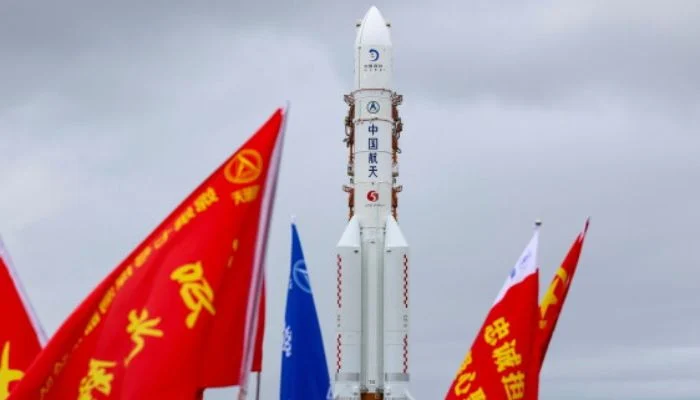

China has announced the delay in the launch of its highly anticipated Chang’e mission, which aimed at exploring the Moon’s south pole and searching for water ice in permanently shadowed craters.
The China Manned Space Agency (CMSA) announced on Sunday, August 23, that the mission will not be launched as it was initially planned, as it didn’t meet the necessary launch conditions.
The agency clarified that the decision was made after through investigation as per the principles of “prudence, reliability, and absolute mission success,” but didn’t offer specific details about the technical or operational issues behind the postponement.
The spacecraft and Long March-5 Y14 rocket, which was carrying the spacecraft, were already placed at the launch site in the Wenchang Spacecraft Launch Site in China’s Hainan Island province.
Although weather was not given as the reason by the Chinese authorities, the National Astronomical Research Institute (NARIT) of Thailand, which has partnered with the Chinese in the project, noted that Tropical Storm Narra had hindered the preparations in the region.
Chang’e-7 is considered one of the most ambitious robotic lunar missions to date. The spacecraft is designed to conduct a comprehensive survey of the Moon’s south pole with the help of an orbiter, lander, rover, and hopping vehicle.
Scientists particularly aimed at exploring the possibility of water ice trapped inside permanently shadowed craters, which can be used for drinking purposes, oxygen, and rocket propellant for future lunar exploration.
This latest delay occurred only about two weeks after another failure in a different Chinese rocket launch. On August 10, a Long March-7A rocket failed in flight when launching the ChinaSat-4B communications satellite.
There is no official announcement yet of a new launch date. The next launch will be dependent on a number of technical, weather, and orbital factors that are necessary for the complex south
2026-08-24 18:39:00