

WASHINGTON: US Immigration and Customs Enforcement (ICE) has approved a $16.7 million procurement contract for 6,000 pairs of electrically activated gloves, adding a new pain-compliance device to the range of equipment available to officers involved in arrests, detainee transfers, and crowd-control operations.
The contract covers not only the gloves themselves but also associated equipment, technical support, and related services. The procurement is expected to be carried out over a period of approximately six months.
Unlike conventional protective gloves, the devices are designed to operate in two modes. During routine use, they function as ordinary patrol gloves. An officer can, however, activate an electrical function that allows the glove to deliver a painful electrical stimulus when it comes into direct contact with a person’s skin.
ICE describes the technology as an intermediate control option intended for situations in which a person refuses instructions, resists restraint, or becomes combative. According to the agency’s procurement justification, the devices could be used during arrests, the movement of difficult detainees, disturbances outside detention facilities, and other situations where officers need to establish physical control quickly.
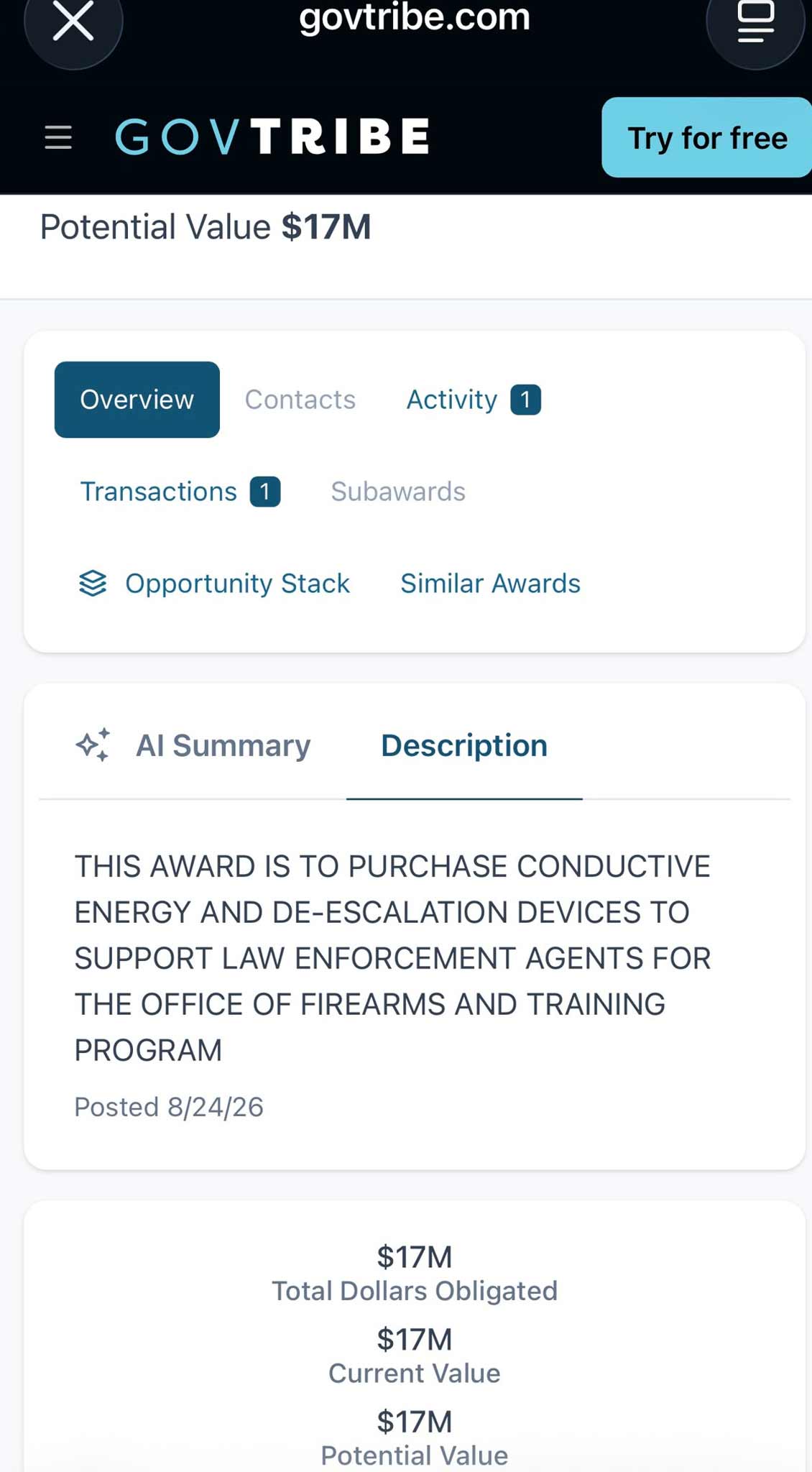
The agency says the objective is to provide personnel with an option that may, in some circumstances, reduce the need for more severe force.
ICE has indicated that the gloves could be used against individuals who are either actively resisting officers or refusing to cooperate physically. The agency also says it may assist officers when attempting to restrain detainees who conceal their hands, become aggressive, or appear likely to attempt escape.
The equipment could additionally be deployed during crowd-management situations connected with detention facilities, according to the procurement documents.
Sole-source procurement
The multimillion-dollar acquisition was made through a non-competitive, sole-source contract, meaning the government did not conduct a conventional competition among multiple manufacturers before selecting the supplier.
The award is structured as a firm-fixed-price contract, under which the government and contractor agree on the price of the specified goods and services in advance.
The procurement has drawn attention not only because of its cost but also because of the nature of the technology being introduced into federal immigration enforcement.
Senators question necessity and safeguards
A group of 16 Democratic senators, led by Nevada Senator Catherine Cortez Masto, has urged ICE to reconsider the acquisition, arguing that introducing a new electrical pain-compliance device requires far greater scrutiny.
In a letter sent to the agency’s acting leadership, the lawmakers sought explanations regarding the operational need for the gloves, the circumstances under which officers would be permitted to activate them, medical risks, training requirements and the mechanisms that would be used to investigate possible misuse.
The senators pointed to previous controversies surrounding immigration enforcement operations in several parts of the United States and argued that ICE should first demonstrate that adequate safeguards and accountability measures are in place.
Their concerns include whether the devices could be used against people who pose little or no physical threat, how every activation would be documented and whether supervisors would be required to review each use.
The lawmakers also questioned why ICE requires another force option when officers already have access to established restraint techniques and other law-enforcement equipment.
Civil rights groups voice concern
Civil rights advocates have separately warned that a device capable of inflicting pain at close range could create new opportunities for excessive or unnecessary use of force.
Their concern is particularly focused on immigration arrests and demonstrations, where encounters between federal officers, detainees, and members of the public have increasingly come under scrutiny.
Critics say the fact that the device must make direct contact with a person’s body raises questions about how officers will distinguish between legitimate restraint and punitive use.
They are also seeking details about whether individuals subjected to electrical shocks would receive medical assessment afterwards and whether ICE would maintain a central record of each incident involving the gloves.
ICE says training and rules will govern use
ICE maintains that the gloves will not be deployed without formal instructions.
The agency says officers will be required to follow approved policies, training procedures, and accountability standards before using the equipment operationally.
However, detailed public guidance setting out when an officer may activate the electrical function, how long contact may be maintained, what medical precautions must be observed, and what supervisory review will follow has not yet been fully outlined in the procurement information made public.
The agency presents the technology as a means of obtaining compliance while potentially avoiding escalation to weapons capable of causing more serious injury.
The controversy surrounding the contract comes amid the Trump administration’s intensified immigration-enforcement campaign, which has increased the visibility of ICE operations across the country and renewed debate over the agency’s use-of-force practices.
For supporters of the acquisition, the gloves represent another tool between verbal commands and more severe force. For opponents, however, the $16.7 million purchase of 6,000 electrically activated devices under a sole-source contract raises significant questions about necessity, proportionality, training, and accountability.
The debate is expected to continue as ICE moves toward distributing the equipment and developing the operational rules governing its use.
2026-08-28 10:09:00