- PM rejects double standards on Iran’s missile capabilities.
- Reaffirms Pakistan commitment to Iran-US mediation efforts.
- Pezeshkian says Pakistan, Iran share deep brotherly relations.
Prime Minister Shehbaz Sharif has clarified that Iran’s ballistic missile programme is not part of the Islamabad memorandum of understanding (MoU) signed between Tehran and Washington to end the Middle East war.
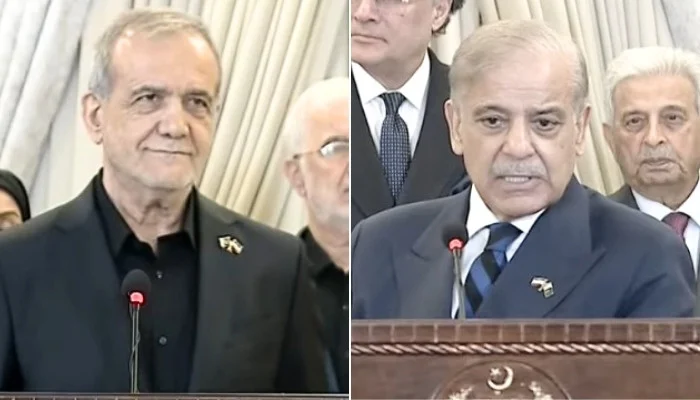
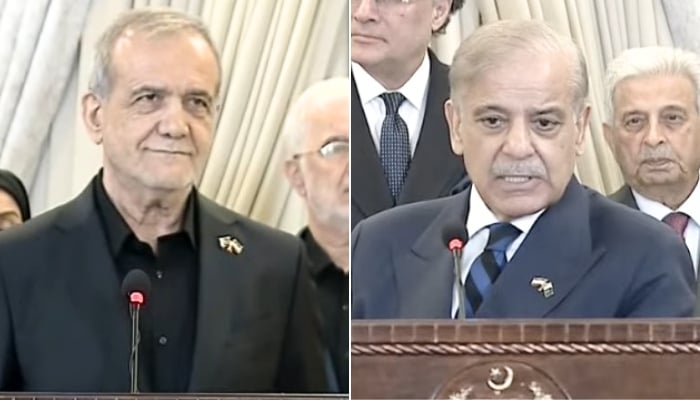
Speaking alongside Iranian President Masoud Pezeshkian during a delegation-level meeting, the premier said there should be no double standards regarding ballistic missiles, saying that Iran had the same right to have them as other countries.
He said that there was no mention of ballistic missiles in the memorandum of understanding agreed between Iran and the United States because the issue was never on the table in those discussions.
Sharif cautioned against the attempts by “spoilers” to misrepresent the agreement and undermine the peace process, saying there should be no confusion or misunderstanding regarding the contents of the MoU.
He argued that it was unfair for some countries to possess ballistic missiles while questioning Iran’s right to do the same.
The prime minister reiterated that, in his capacity as mediator, he could state unequivocally that the MoU does not mention ballistic missiles in any form and urged observers not to misconstrue the agreement.
PM Shehbaz reaffirmed Pakistan’s commitment to continuing its mediation efforts between Iran and the United States, saying Islamabad would play its role until a lasting and honourable peace is achieved.
He praised the courage and resilience of the Iranian leadership and people, expressing appreciation for their steadfastness during a challenging period for the country.
The prime minister also commended Chief of Defence Forces (CDF) and Chief of Army Staff (COAS) Field Marshal Syed Asim Munir for his outstanding contribution to securing the ceasefire and facilitating the signing of the Islamabad MoU.
He added that the progress achieved in the peace process would not have been possible without the support of friendly countries, including Qatar, Saudi Arabia, Turkiye, and Egypt.
He said Pakistan would do everything humanly possible to prevent a wider conflict, warning that war could engulf vast areas and have devastating consequences for the region.
He expressed optimism about the future, saying the parties were now working towards a brighter path and reiterating Pakistan’s determination to support peace, stability and dialogue.
Following the talks, PM Shehbaz and President Pezeshkian addressed a joint press conference in Islamabad, reaffirming their commitment to stronger bilateral relations, regional peace and continued cooperation.
The premier described his discussions with the Iranian president as highly productive and said Pakistan would remain grateful to the Iranian leadership for placing its trust in Islamabad’s efforts to facilitate peace negotiations.
He said Iran’s success was Pakistan’s success, while Islamabad would also feel any setback for Tehran.
The Iranian president said relations between Pakistan and Iran were unique and founded on deep historical, cultural and religious ties. He added that the people of both countries are sharing a common future and destiny.
Pezeshkian said Pakistan was not only a neighbouring state but also a brotherly nation and a close friend. He expressed confidence that ties between Tehran and Islamabad would continue to strengthen across multiple sectors.
He thanked the government and people of Pakistan for their support and acknowledged Islamabad’s contribution to peace, development and prosperity in the region.
He said the signing of the Islamabad MoU reflected Iran’s confidence in Pakistan’s mediation efforts.
The Iranian president added that he had held productive meetings with President Asif Ali Zardari, PM Shehbaz and CDF Munir, during which bilateral relations and regional developments were discussed.
2026-06-23 21:21:00
News Source