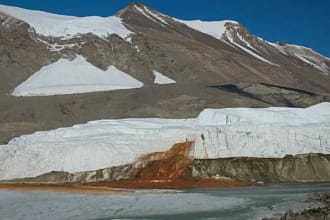



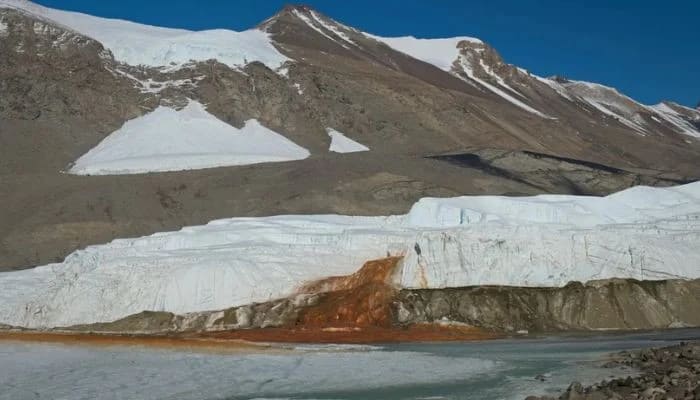

Scientists have found a major clue about the origins of red Blood Falls in East Antarctica’s Taylor Valley. The red colored brine oozing out of a haunting waterfall was believed to be rich in iron; however, scientists may now have developed a new theory.
According to a new study published in the journal Nature Geoscience, experts have identified the salty origins of the red brine, adding molecular and genetic evidence to the already available ancient seawater origins.
The study states: “Findings in this study reveal dominance of marine eukaryotic lineages in the Blood Falls area,” adding, “This marine signal is less prominent but still detectable in the prokaryotic structure.”
Researchers analysed 167 samples of water, sediment and air from around the falls and other nearby areas and found that Blood Falls samples possess 9% eukaryotes in common with the ocean while the others only showed about 1% similarity.
Researchers say the new findings strengthen the long-standing theory that Blood Falls originated from an ancient pocket of seawater trapped beneath Taylor Glacier millions of years ago.
By uncovering a strong marine genetic signature in the red brine, the team argues that the mysterious outflow preserves evidence of an ancient marine ecosystem that became isolated beneath the Antarctic ice sheet.
The researchers said the discovery could improve understanding of how microbial life survives in extreme environments and may also help scientists search for life beneath the icy surfaces of other worlds, such as Jupiter’s moon Europa and Saturn’s moon Enceladus.
2026-08-03 22:24:00