



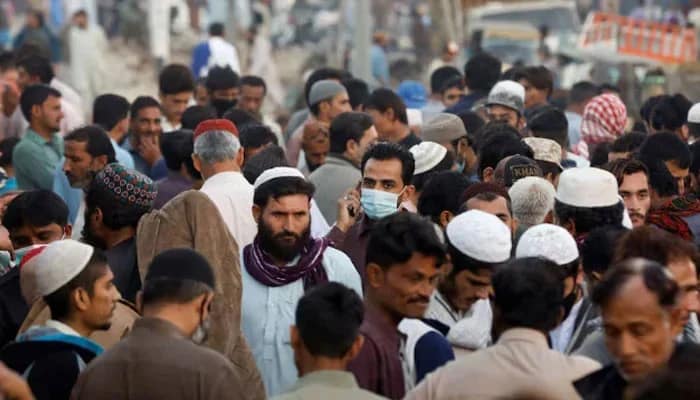
National security is no longer defined solely by territorial defence, as nation states are increasingly tested by their ability to provide water, food, energy, jobs and enterprise opportunities to rapidly growing populations. Demographic pressures amplify every existing vulnerability, complicating and straining governance, accelerating urbanisation, intensifying resource competition and complicating long-term planning. Hence, population growth is not a standalone issue.
Every year we debate inflation, debt, exports and growth targets. But beneath all these challenges lies a force quietly overwhelming every reform we attempt — population growth.
Pakistan has 256 million people today. By 2050, that number could reach 390 million. In the lifetime of children already sitting in our classrooms, we may add another 134 million citizens — the equivalent of a whole new country the size of Mexico, added to one already struggling to educate, employ and provide healthcare to the people it has now.
Can our schools absorb that? Our hospitals? Can our labour market create enough jobs in an age of artificial intelligence? Can our water, food and energy systems sustain such numbers in one of the world’s most climate-vulnerable countries?
At the recent post-budget press conference, Finance Minister Muhammad Aurangzeb was asked about the removal of taxes on contraceptives in the Fiscal Year 2026-27 Budget. His answer was direct: “If today, with a population of 250 million, you are highlighting child stunting and learning poverty — primarily girls out of school — then can you imagine what will happen if we reach 300 to 400 million?” He called it an existential issue. Then he said, on the record, that when the next NFC Award is allocated, the population formula “has to be reviewed and has to change”. Naming a problem and committing to fix it takes moral courage.
Addressing this requires thinking across three interlocking domains: people, process, and policy tools.
Nearly 40% of Pakistani children under five are stunted — their physical and cognitive development permanently damaged before their fifth birthday. We rank third in the world for child stunting, with the worst numbers in Balochistan and Sindh. A stunted child earns less, produces less, and depends more on public services for their entire working life.
The fix requires outcome-linked nutrition interventions. Antenatal care, postpartum family planning, and supplementation need to reach mothers through basic health units, with funding tied to verified reductions in stunting rates, district by district. The Lady Health Worker, the Basic Health Unit: that is where this either happens, or it does not.
Then there is the learning crisis. Nearly 78% of 10-year-olds cannot read a simple sentence. One in four primary school-aged children is not in school at all. Our learning poverty rate was already 16 percentage points above the South Asian average before the 2022 floods made it worse. We keep measuring the wrong things — schools built, teachers hired — rather than what a child in Grade 3 can do.
Female education sits at the centre of all of this. Female literacy in Pakistan is 46.5%. Women with no education have, on average, more than four children. Every percentage point improvement in girls’ secondary school enrolment measurably reduces the fertility rate. Girls’ education is a population policy. It is also a climate policy, because smaller, better-educated households consume fewer resources and make more sustainable use of the land and water on which Pakistan’s food security depends.
Female labour force participation stands at 24% — among the lowest in the world. By 2050, the number of women of reproductive age will nearly double. When women work and earn, family sizes fall, child nutrition improves, and these gains compound across generations. Educating girls and bringing women into the economy is the highest-return investment available to this country.
Pakistan has over 4,000 technical and vocational training institutions. Employers still cannot find the skilled graduates they need. The intervention point needs to move earlier — to middle school. Employer-designed technical skills should be embedded into formal schooling from Grade 6 onward. A 13-year-old should begin building market-relevant skills rather than waiting for a degree that may never lead to meaningful work. A young person who lands a good job invests in fewer, better-educated children. A functioning Labour Market Information System can bridge that gap.
On governance: the 18th Amendment transferred health and population functions to the provinces in 2010. The result was fragmentation — one national programme split into four provincial bureaucracies of uneven capacity. The Federal Task Force on Population has not met since November 2021. Of more than 130 workstreams in the 2018 National Action Plan, fewer than a third have been completed and almost a fifth never started. The well-intentioned plan failed because it had no binding accountability, no milestones tied to money, and no consequences for underperformance.
We do not need to reverse the 18th Amendment. We already have tools to make provinces fiscally invested in the outcome. The most powerful is the NFC Award — the formula that determines how federal resources are distributed to provinces.
Currently, 82% of the provincial allocation is driven by raw population size. Provinces with larger, faster-growing populations receive more money, more parliamentary seats, and more federal jobs. We have built a system that rewards high fertility, then spend billions on conferences, wondering why the fertility rate will not fall.
The 11th NFC reform must change this. The formula should introduce performance-linked parameters: provinces that reduce fertility rates receive more, not less; provinces that improve health and education outcomes are rewarded; provinces that protect forests and build climate resilience are recognised; and provinces with vast, sparsely populated territory receive fair recognition for the real cost of delivering services across such distances.
Alongside a revised formula, a Population Stabilisation Performance Grant — disbursed only when independently verified results are delivered — can provide the direct signal the formula alone cannot. Contraceptive coverage, fertility reduction by province, girls’ enrolment, infant mortality, Lady Health Worker deployment: these become the measures that move money. Provinces that hit their targets earn a bonus. Those that fall significantly short face delayed disbursements until they produce a credible remedial plan.
The Population Council’s modelling shows that bringing Pakistan’s fertility rate to replacement level by 2035 increases per capita income by 37% by 2050.
Pakistan ranks among the 10 countries most exposed to climate change. Per capita freshwater availability has fallen from 5,000 cubic metres in 1947 to roughly 1,000 today. These two crises — demographic and ecological — are the same crisis. Stabilising Pakistan’s population at 280 to 300 million rather than 370 to 390 million by 2050 preserves the water entitlement of tens of millions from an already critically stressed river system. An ecological performance weight in the NFC formula would make it Pakistan’s most powerful climate finance instrument at the subnational level.
This is not untested thinking. Bangladesh took its fertility rate from 6.9 to 2.0 across 5 governments and 40 years, at a cost of $13 to $18 per birth averted. India embedded demographic performance incentives in its 15th Finance Commission.
Pakistan has made a start. The prime minister has pledged an education emergency. The finance minister has committed to reforming the NFC population driver. Removing taxes on contraceptives is a meaningful signal.
What remains is the harder task: redesigning, in a single reform cycle, the fiscal architecture that has for decades rewarded population growth and penalised the provinces willing to change course. The choices made in the next decade — on population, girls’ education, nutrition, skills, women’s economic participation, and the fiscal incentives that drive behaviour and delivery — will determine whether Pakistan enters its centenary as a confident middle-income nation or spends another generation struggling to keep up with its own demographics.
The author is currently the Adviser to the Federal Minister for Finance and Revenue. He can be reached at: [email protected]
Disclaimer: The viewpoints expressed in this piece are the writer’s own and don’t necessarily reflect Geo.tv’s editorial policy.
2026-06-22 19:32:00