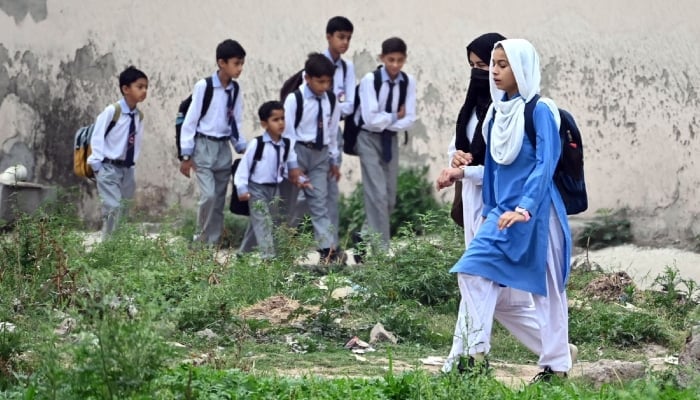
The Punjab government’s decision to transfer management of selected government schools to private partners, civil-society organisations, and educated young licensees has sparked sharp debate.
Critics call it privatisation, while supporters describe it as reorganising failing public schools. Under the Public Schools Reorganisation Program (PSRP), school buildings remain public assets, education remains free for students and the government pays operators against verified enrolment and other prescribed conditions. The model is therefore publicly financed and privately managed through partnership, rather than the outright sale of public education.
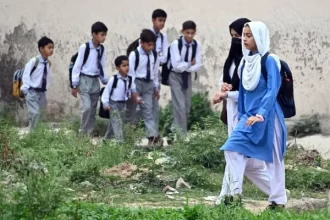
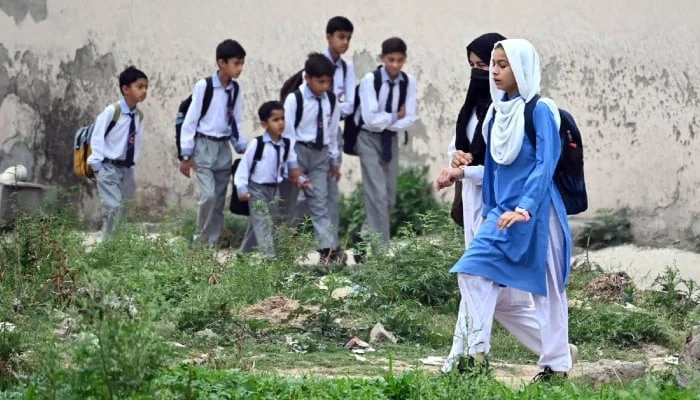
The province has a vast network of more than 52,000 public schools serving around 12 million enrolled children, yet it still has an estimated 9.5-9.7 million children aged five to sixteen out of school. This is the largest absolute number of out-of-school children in any of our provinces.
Any fair discussion must acknowledge many government schools which continue to serve their communities with dedication, and thousands of teachers perform honourably under difficult conditions. Yet the system has also carried deep-rooted weaknesses: thousands of schools with very low or zero enrolment, single-teacher institutions, buildings in disrepair, weak classroom management and children progressing through grades without mastering basic reading or arithmetic. The programme’s own terms identify weak enrolment, zero-teacher, single-teacher and two-teacher primary schools as requiring reorganisation.
With all that, the learning crisis is particularly serious. ASER Pakistan has repeatedly shown over the past decade that many children in Grade 5 cannot read a Grade 2-level story or complete basic division. The 2025 national findings still indicated that only about half of Grade 5 pupils in both government and private schools could hardly read the expected simple story text, meaning years of enrolment do not automatically produce foundational learning.
While Punjab has performed better than some other provinces on several education indicators, ‘better than others’ is not the same as good enough. A child who spends five years in school and remains unable to read fluently has been present in the system but has not truly received quality education.
Teacher absenteeism is another persistent concern, although it should not be exaggerated into the claim that every public-school teacher is absent or ineffective. Multiple studies have found that absenteeism, lenient supervision, transport, water and sanitation difficulties and the security attached to permanent employment can reduce teaching time. Earlier reform and monitoring programmes improved attendance in many areas, demonstrating that the problem responds to accountability.
An institutional culture of permanent employment-without-meaningful-appraisal has created a belief that salary progression is guaranteed regardless of classroom performance. On top of it, some teachers remain disconnected from revised curricula, digital learning, modern assessment, inclusive education and activity-based teaching methods. When their salaries, benefits and pensions represent a major public investment, the return must also be measured in children’s attendance, safety and learning, not merely in filled posts and completed registers.
While all this is true on teachers’ part, they are not the only cause of a compounded failure. Officials must also acknowledge irrational transfers, political interference, teacher deployment imbalances, inadequate professional development, poor school leadership and delayed maintenance. Some schools have several teachers but few pupils; others serve crowded communities with one teacher.
Under the much-criticised formula, the government has invited educated individuals and organisations to manage selected schools under the oversight of the Punjab Education Foundation (PEF), the Punjab Education Initiative Management Authority (PEIMA), and related public institutions. In the young-entrepreneur category, the lead applicant is required to hold at least 16 years of education, while other group members must possess graduate-level qualifications. This provides highly educated local youth – many of whom presently face unemployment – with an opportunity to become school leaders, employers and community educators through a rigorous merit-based selection system.
The major promise of this model lies in local ownership. A licensee whose continuation depends on enrolment, attendance, school condition and learning performance has a direct incentive to visit homes, convince parents, recruit teachers responsibly and keep the school functioning. In several reorganised schools, operators have done major classroom repairs, improved cleanliness, arranged drinking water, constructed toilets, planted trees, created colourful learning spaces and run enrolment campaigns without any additional budgetary allocations. PEF’s robust model of repeated instructions on infrastructure, repairs, cleanliness, assessments and student-data verification shows that it is built around ongoing compliance rather than a one-time handover.
It is also important to mention that these schools operate with relatively modest per-child subsidies. Under established PEF programmes, monthly assistance has historically ranged from Rs750 at the earliest levels to Rs1,200-1,800, although programme-specific rates may differ and should be revised for inflation. The important point is that partners are expected to educate children at a fraction of the full cost of maintaining buildings, permanent cadres, allowances, pensions and administrative hierarchies in directly managed schools.
Above all, the reform deserves appreciation. The provincial government has shown political courage by challenging a system in which abandoned buildings and nearly empty classrooms could continue consuming resources without urgency.
Still, two negative impacts require serious safeguards. First, low-cost management can put undue stress on a highly educated yet unemployed licensee, produce an underpaid and insecure teaching workforce, and under-care for infrastructure. International experience warns that privately managed public schools do not automatically outperform traditional schools; results depend on operator quality, regulation and adequate financial support.
Article 25-A of the constitution must remain the programme’s foundation: the state must provide free and compulsory education to children aged five to sixteen. Outsourcing management does not outsource constitutional responsibility.
Internationally, England’s academies remain publicly funded and free but are operated by independent trusts with greater managerial autonomy and external inspection. In the US, charter schools are tuition-free public schools governed through performance agreements. These examples demonstrate that autonomy can coexist with public financing, but only when contracts, admissions, inspection and accountability are strong.
Payments should include a fixed component for stability and a performance component based on verified learning progress – not raw examination scores alone. Remote schools should receive higher subsidies because equal funding for unequal conditions produces unfair results.
The programme should also establish district resource hubs that provide shared science laboratories, libraries, counsellors, special-education support and digital lessons. Universities should mentor clusters of schools, while education graduates should complete supervised teaching residencies in reorganised institutions.
The initiative should eventually extend beyond Grade 8 by introducing publicly funded high schools, community colleges, associate-degree campuses, technical institutes and selected graduation-level institutions in underserved tehsils. Many rural students complete school but cannot afford transport, accommodation or university fees. Locally managed post-secondary institutions could provide teacher education, information technology, nursing support, agriculture, and climate-smart farming and entrepreneurship programs linked with district labour markets.
The government should therefore stick to the reform, but improve it continuously. Punjab does not need privatisation for its own sake. It needs a public education system where ownership matters less than access, learning, dignity and accountability. Where a government-managed school succeeds, strengthen it. Where it has failed for years, new management deserves a fair chance. The ultimate test is simple: the child enters, learns, stays safe and moves towards a better life.
The writer is a climate governance expert. He can be reached at: [email protected]
Disclaimer: The viewpoints expressed in this piece are the writer’s own and don’t necessarily reflect Geo.tv’s editorial policy.
Originally published in The News
2026-10-10 09:13:00