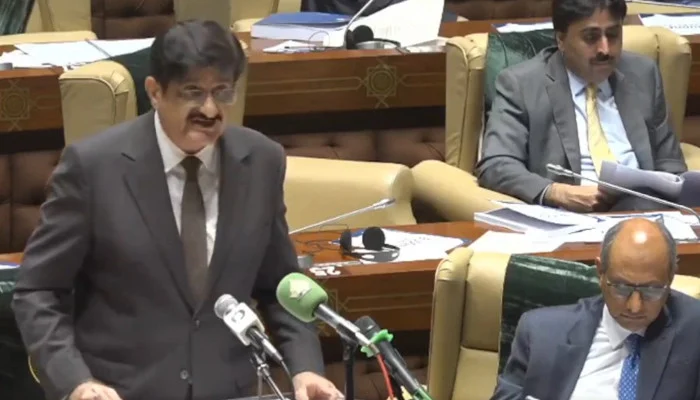
KARACHI: Sindh Chief Minister Murad Ali Shah presented the provincial budget for the financial year 2026-27 in the Sindh Assembly on Wednesday, proposing a 7% increase in salaries and pensions for provincial government employees.
Delivering his budget speech, CM Murad expressed gratitude for presenting Sindh’s budget for the 12th time.
During the budget session, opposition lawmakers staged a protest in the assembly, raising slogans of “rejected, rejected” as the chief minister continued his address.
The Sindh CM presented a budget worth Rs3.562 trillion for the new financial year, saying the provincial government had imposed no new taxes in the budget.
He also expressed the government’s commitment to providing relief to the public and the business community.
In his budget speech, the Sindh chief minister proposed an increase of 7% in salaries and pensions of the government employees.
He also announced the merger of the adhoc relief allowances granted in 2022 and 2025 for provincial government employees.
Further, he said that the minimum monthly wage in Sindh had been increased from Rs40,000 to Rs43,000.
CM Murad also announced plans to establish a Sindh International Financial Centre in Karachi, saying it will serve as a platform for infrastructure finance, Islamic finance and climate finance.
He also reiterated the government’s commitment to transforming Keti Bandar into a global maritime, logistics, industrial and energy hub.
Meanwhile, Opposition Leader in the Sindh Assembly Ali Khursheedi rejected the budget, calling it a “one-sided” budget.
“We reject such a budget,” he told the media outside the Sindh Assembly, saying that a complete pre-budget session should have been held in accordance with the rules but was not conducted.
“Unfortunately, the current rulers have not upheld democratic norms. A one-sided budget is being presented here,” he said.
Khursheedi further said the united opposition was present together and protesting against the budget and the manner in which it was presented.
Budget features
The budget has been set at Rs3.65 trillion against estimated receipts of Rs3.41 trillion, leaving a projected deficit of Rs242 billion.
The Sindh chief minister said that Rs400 billion has been allocated for the development programme, and Rs13.2 billion for the social protection package.
According to CM Murad, the provincial government had prepared its financial plan amid a challenging global and domestic environment marked by geopolitical tensions, inflationary pressures, climate-related risks and economic uncertainty.
The chief minister said that Sindh’s budget strategy for the coming year was guided by four principles: safeguarding the province’s constitutional rights, maintaining fiscal sustainability, contributing to national stability and continuing investment in public welfare.
He said that the provincial government had been compelled to reduce its development portfolio from a projected Rs575 billion to Rs400 billion after contributing towards national strategic requirements under a negotiated arrangement with the federal government.
“Even in a difficult fiscal environment, we have protected priority development projects and essential public services that directly affect the lives of our people,” he said.
The Annual Development Programme for the fiscal year 2026-27 allocates Rs25.9 billion for education, Rs17.4 billion for health, Rs121.6 billion for local government and municipal infrastructure, Rs40.9 billion for public health engineering, Rs30.9 billion for irrigation, Rs39.5 billion for transport and communications and Rs6.3 billion for agriculture and livestock.
According to CM Murad, the province had achieved the highest development spending in its history during the outgoing fiscal year, releasing more than Rs900 billion for development activities.
Relief measures
The chief minister announced that there would be no new taxes in the coming fiscal year and instead unveiled a series of relief measures aimed at supporting education, agriculture, insurance and employment sectors.
Among the measures announced were a reduction in sales tax on education support services to 5%, continuation of concessional tax rates for overseas employment recruiting agencies and beauty salons integrated with point-of-sale systems, and reductions in taxation applicable to insurance agents and brokers.
The provincial government has also proposed increasing the exemption threshold for agricultural super tax from Rs150 million to Rs500 million and reducing the applicable rate from 10% to 8%.
The chief minister also announced a Rs13.2 billion social protection package comprising the Kitchen Garden Initiative, Benazir Hari Card Programme, Benazir Women Agriculture Workers Programme and support schemes for widows and orphans.
This is a developing story and is being updated with further details.
2026-06-17 17:14:00