Sign In
  • National
  • International
  • Fact Check
  • Research
Truth Wire | Authentic News Platform with Independent Journalism
  • Home
  • National News
  • World
  • Technology
    • Check out more:
    • Fashion
    • Travel
    • Business
    • National News
    • World
  • Business
  • Entertainment
  • Health
Reading: Stolen water, poisoned rivers
Share
Truth Wire | Authentic News Platform with Independent JournalismTruth Wire | Authentic News Platform with Independent Journalism
Font ResizerAa
  • World News
  • Pakistan
  • Technology
  • Sports
  • Entertainment
  • Amazing Lifestyle
Search
  • Home 1
  • Categories
    • Technology
    • Pakistan
    • Amazing Lifestyle
    • Entertainment
    • World News
    • Sports
    • Health
  • Bookmarks
  • Sitemap
Have an existing account? Sign In
Follow US
© 2022 Foxiz News Network. Ruby Design Company. All Rights Reserved.
BusinessLatest

Stolen water, poisoned rivers

Managing Editor
Last updated: August 3, 2026 12:16 pm
Managing Editor
Share
SHARE

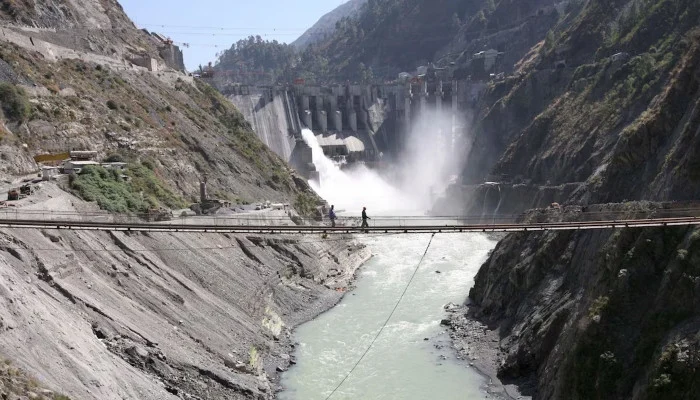
Labourers walk on a bridge near the 450-megawatt hydropower project located at Baglihar Dam on the Chenab river which flows from IIOJK into Pakistan, at Chanderkote, about 145 km (90 miles) north of Jammu, October 10, 2008. — Reuters

The Chenab is more than a line on a map. It’s a lifeline, a civilisational corridor, a fragile Himalayan system carrying snowmelt, sediment, memory and risk in equal measure.

So, when India talks about diverting its waters into the Beas basin, that can’t simply be waved through as an internal engineering adjustment. It is a transboundary act, with ecological, legal, geological and human consequences that reach far beyond its own borders.

Recent reports about a proposed Chenab-Beas link have understandably rattled Pakistan. The idea, as reported, is to draw water from the upper Chenab system – possibly through a tunnel near the Chandra river in Himachal Pradesh – and send it into the Beas. Wider plans talk about moving ‘surplus’ water through canal networks towards Punjab, Haryana and Rajasthan. But in the Indus basin, words like surplus and diversion are never innocent. One country’s surplus can be another country’s sowing season, aquifer recharge, delta survival or floodplain ecology.

What makes this serious is that the Chenab isn’t one of the eastern rivers under the Indus Waters Treaty. It belongs to the western river system, allocated largely to Pakistan, with only limited uses permitted to India. If India now wants to redraw these hydrological realities through tunnels and link canals, even while stepping back from the treaty itself, that goes well beyond engineering. You can’t hollow out a treaty by drilling through a mountain.

Pakistan’s response shouldn’t rest on treaty language alone. The stronger case here is environmental and scientific. No Chenab-Beas diversion should go ahead without full disclosure of design discharge, annual diversion volume, barrage storage, tunnel alignment, fault-line mapping, GLOF risk, sediment modelling, reservoir operation rules and an assessment of cumulative reservoir-induced seismicity. Call these technical details if you like; in one of the world’s most fragile mountain systems, they function as safeguards.

The Himalaya is an active seismic region. A tunnel through this terrain cuts across faulted rock, groundwater channels, stress zones and landslide-prone slopes. It can disturb drainage, sediment movement and unstable formations, especially now, with glacial melt and extreme rainfall both intensifying under a warming climate.

The tunnel itself may be short, but the ambition behind it isn’t. Even a diversion of one or two million acre-feet a year would matter downstream, and reported pre-feasibility discussions have floated numbers as high as 15 to 20 million acre-feet annually. The three eastern rivers – Ravi, Beas and Sutlej – carry roughly 33 million acre-feet a year between them. At the higher end, diverted Chenab water could amount to nearly half, perhaps three-fifths, of that entire volume. Feed that into already-large Beas-Sutlej storage systems and the question of cumulative seismic risk isn’t something to brush aside.

Reservoir-induced seismicity is a documented phenomenon: large reservoirs can alter stress in already-strained geological zones, and the weight of stored water, along with its infiltration into fractured rock, can under certain conditions help trigger earthquakes.

There’s another silence running through this water debate: pollution. For decades, Pakistan hasn’t just lost clean flows; it’s also been receiving poisoned ones in their place. The Hudiara Drain, starting near Batala and Amritsar, enters Pakistan carrying industrial effluent and municipal sewage, flows past Lahore’s expanding settlements, and empties into the dry bed of the Ravi. Its average flow is about 180 cusecs. Over the life of the treaty, that works out to nearly 10 billion cubic metres of polluted wastewater crossing into Pakistan from this single drain – an estimated 10-15% of all Ravi pollution. Heavy metals, arsenic, lead, zinc, E coli, untreated chemicals: none of it stops at the border. It ends up in groundwater, vegetables, fodder, milk, meat, and eventually human bodies.

That gives Pakistan a second claim, not just about water quantity, but water quality. Under the polluter-pays principle, India should have treated this wastewater before it ever crossed the border. Conservative estimates put the treatment cost at over $20 billion. Factor in environmental degradation, agricultural losses, groundwater damage and public health impacts across the Ravi basin, and Pakistan’s rightful compensation claim could run anywhere from $75-135 billion. None of this is rhetorical flourish and staying silent now would mean accepting both theft and poison as Pakistan’s permanent fate.

India has a right to pursue its own development. Pakistan has an equal right to survival. A river cannot be treated like a pipeline. Before the Chenab is pushed toward the Beas, every discharge figure, fault map, reservoir rule and pollution liability needs to be on the table. Anything less would be reckless – not just for Pakistan, but for the Himalaya itself.


The writer is an expert on climate change and sustainable development and the founder of the Clifton Urban Forest. He tweets/posts @masoodlohar and can be reached at: [email protected]


Disclaimer: The viewpoints expressed in this piece are the writer’s own and don’t necessarily reflect Geo.tv’s editorial policy.


Originally published in The News


2026-08-03 09:21:00

Subscribe to Our Newsletter
Subscribe to our newsletter to get our newest articles instantly!

Share This Article
Email Copy Link Print
Previous Article Palace gives nod to Prince Edward as he performs key role on King’s behalf
Next Article Babar Azam opens up on omission of Mohammad Abbas from second WI Test
Leave a Comment

Leave a Reply Cancel reply

Your email address will not be published. Required fields are marked *

Editor's Pick

The Best Wireless Gaming Headsets in This Year

As for quality, the HS80's provided clear-cut sound with adequate bass and a slight emphasis on the mid-range, making those…

4.8 out of 5Good
5 Tips for Charging an Electric Vehicle More Easily

Politics is the art of looking for trouble, finding it everywhere, diagnosing…

4 Min Read
Google Must Allow Developers to Use Other Payment Systems

Modern technology has become a total phenomenon for civilization, the defining force…

4 Min Read

Top Writers

kaylene0943

Oponion

Zayn Malik, Gigi Hadid’s daughter turns 6: Inside the sweet celebrations

Zayn Malik, Gigi Hadid’s daughter turns 6: Inside the sweet…

September 20, 2026

William, Harry joint response to Charles Spencer bombshell: ‘Painful’

William, Harry joint response to Charles…

September 20, 2026

Cancer-stricken King Charles takes decision as ‘unkind’ claims take toll

King Charles friend gives update on…

September 20, 2026

Frankie Muniz, estranged wife Paige Price celebrate son’s big win together

Despite their rough patch, the parents…

September 20, 2026

Govt ‘exits’ electricity purchase system as first-ever power wheeling auction begins

Federal Minister for Energy Sardar Awais…

September 20, 2026

You Might Also Like

EntertainmentLatest

Jennifer Lopez birthday message has fans cheering

Jennifer Lopez birthday message has fans cheering Jennifer Lopez is celebrating another trip around the sun—and she's making it clear she's…

6 Min Read
EntertainmentLatest

Bruce Campbell’s latest cancer update shock fans

Bruce Campbell's latest cancer update shock fans Bruce Campbell isn’t letting cancer call the shots.The Evil Dead star opened up about…

6 Min Read

Three Rangers personnel martyred, as many terrorists killed in attack on Karachi camp: ISPR

Paramilitary soldiers arrive to cordon off the streets around the Mosamiat Chowrangi area after a militant attack on Pakistan's Security…

7 Min Read
BusinessLatest

Princess Eugenie ‘declines’ Sarah Ferguson rift stories with generous move

Princess Eugenie 'declines' Sarah Ferguson rift stories with generous moveSarah Ferguson's big secret is finally out, and it proves there…

6 Min Read
Truth Wire | Authentic News Platform with Independent Journalism

News

  • World News
  • Advertise

Technology

  • Technology

Health

  • Medicine
  • Children
  • Coronavirus
  • Nutrition

Culture

  • Stars
  • Screen
  • Culture
  • Media
  • Videos

More

  • Entertainment
  • Amazing Lifestyle
  • Pakistan
  • Sports
  • Health

Subscribe

  • Home Delivery
  • Digital Subscription
  • Games
  • Cooking
© Foxiz News Network. Ruby Design Company. All Rights Reserved.

Powered by
►
Necessary cookies enable essential site features like secure log-ins and consent preference adjustments. They do not store personal data.
None
►
Functional cookies support features like content sharing on social media, collecting feedback, and enabling third-party tools.
None
►
Analytical cookies track visitor interactions, providing insights on metrics like visitor count, bounce rate, and traffic sources.
None
►
Advertisement cookies deliver personalized ads based on your previous visits and analyze the effectiveness of ad campaigns.
None
►
Unclassified cookies are cookies that we are in the process of classifying, together with the providers of individual cookies.
None
Powered by
Welcome Back!

Sign in to your account

Username or Email Address
Password

Lost your password?

Not a member? Sign Up