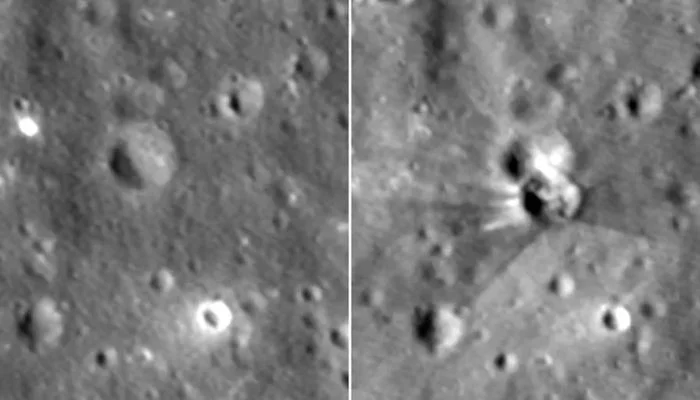

A SpaceX rocket that had been drifting through space for more than a year has slammed into the Moon, leaving behind a brand-new crater that NASA has now photographed for the first time.
NASA’s Lunar Reconnaissance Orbiter captured before-and-after images of the lunar surface between August 11 and 12, revealing the damage caused by the Falcon 9 rocket’s upper stage. Scientists estimate that the newly formed crater is about 60 feet (18 metres) wide and less than 10 feet deep.
The impact happened on August 5, when the discarded upper stage crashed into the Moon at an estimated 5,400 mph (8,700 km/h). The rocket section weighed around 8,800 pounds and had been travelling through space since its January 2025 launch.
The Falcon 9 upper stage was launched in January 2025 to carry Firefly Aerospace’s Blue Ghost 1 lunar mission. Unlike the reusable first stage of a Falcon 9, the upper stage was left in space after completing its job. It then spent more than a year drifting around Earth before gravitational forces and solar radiation gradually altered its trajectory.
Eventually, the rocket’s path brought it into the Moon’s vicinity, resulting in the unexpected collision. The crash occurred near the Einstein crater on the Moon’s far side, making it particularly difficult for observers on Earth to detect. The new images show a fresh crater surrounded by bright and dark streaks extending across the lunar surface.
NASA said the darker material came from the weathered upper layers of the Moon, while the brighter streaks consist of material excavated from deeper beneath the surface. South Korea’s Danuri lunar orbiter captured the first images of the impact site shortly after the crash.
NASA’s LRO then photographed the location from multiple angles, allowing scientists to study the crater in much greater detail. There was no danger to Earth, but the unexpected impact highlights a growing problem as humanity sends more spacecraft toward the Moon.
As lunar missions increase, discarded rocket stages and other spacecraft could potentially become a hazard for future lunar bases, equipment and astronauts.
Scientists can also use the unexpected impact to better understand how objects strike the Moon and how much material those collisions throw across its surface.
2026-08-19 23:26:00